Understanding What’s Really Happening Inside Your Liver
The liver rarely announces trouble early. Fatigue, mild abdominal discomfort, or slightly yellow skin often appear only after significant liver stress has already been building quietly for months or years. Whether the cause is a viral infection, iron or copper overload, or simply the need for a baseline health check, the right combination of tests tells a far more complete story than any single number alone.
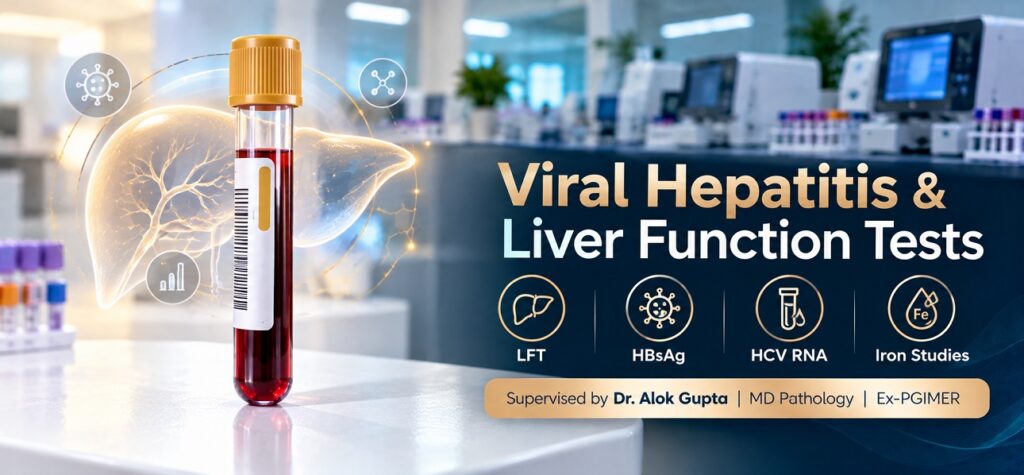
This guide covers the viral hepatitis and core liver function panel Altus Lab offers. For autoimmune liver disease, tumor markers, and specialized pancreatic and fungal infection tests, read our companion guide covering that separate category.
Dr. Alok Gupta, MD Pathology, Ex-PGIMER Chandigarh, supervises every test here, with home sample collection available across Chandigarh, Mohali, and Panchkula.
Liver Function Test (LFT) – Complete
The Complete Liver Function Test combines several individual markers, including bilirubin, liver enzymes, total protein, and albumin, into one comprehensive report. Consequently, your doctor gets a broad snapshot of how well your liver is processing waste, producing proteins, and maintaining normal metabolic function, all from a single blood sample.
Doctors recommend this test as a starting point for nearly any liver concern, whether investigating unexplained fatigue, jaundice, abdominal discomfort, or simply as part of a routine annual health checkup. Abnormal results here typically guide which additional, more specific tests make sense next.
At Altus Lab, LFT results are typically ready within 24 hours. Because this test requires only a routine blood draw with no special preparation, it remains one of the most practical and valuable additions to any comprehensive health checkup, catching early warning signs before symptoms fully develop.
Hepatitis B Surface Antigen (HBsAg)
HBsAg testing detects a protein present on the surface of the Hepatitis B virus, making it the primary screening test used to identify current Hepatitis B infection, whether recently acquired or chronic. A positive result confirms active infection, while a negative result generally rules out current Hepatitis B.
This test matters significantly beyond individual diagnosis, since HBsAg screening is routinely required during pregnancy, before certain medical procedures, and for blood donation eligibility, reflecting how important early identification is for preventing transmission and guiding appropriate medical management for the infected individual.
At Altus Lab, we recommend HBsAg testing as a standard screening test for anyone with risk factors, anyone planning pregnancy, or simply as part of comprehensive preventive health screening, since Hepatitis B often causes no symptoms for years while quietly affecting liver health.
Hepatitis B Viral Load (HBV DNA PCR)
HBV DNA PCR measures the actual quantity of Hepatitis B virus present in your blood, offering far more clinically useful information than HBsAg alone once infection has already been confirmed. This test tells your doctor exactly how actively the virus is replicating in your body.
This distinction matters enormously for treatment decisions, since viral load directly influences whether antiviral treatment is currently necessary, and later, whether that treatment is working effectively. Doctors also use serial viral load testing to monitor disease progression and treatment response over months and years.
At Altus Lab, we process this quantitative PCR test for patients with confirmed Hepatitis B requiring treatment monitoring, and for those newly diagnosed who need baseline viral load established before their hepatologist decides on the most appropriate management approach for their specific situation.
HBeAg & Anti-HBe
HBeAg and Anti-HBe testing provides additional clarity about Hepatitis B infection activity and infectivity. HBeAg presence generally indicates active viral replication and higher infectivity, while its disappearance, alongside the appearance of Anti-HBe antibodies, often signals a shift toward lower viral activity, called seroconversion.
This seroconversion represents an important clinical milestone that doctors specifically watch for during Hepatitis B management, since it often correlates with improved long-term outcomes, though the relationship isn’t absolute and requires interpretation alongside viral load and liver function results together.
At Altus Lab, we recommend this test alongside HBV DNA PCR for patients with chronic Hepatitis B, since tracking these markers over time helps your hepatologist understand disease trajectory and make informed decisions about starting, continuing, or adjusting antiviral treatment.
Anti-HCV Antibody (3rd Gen)
Anti-HCV Antibody testing screens for exposure to Hepatitis C virus, using third-generation technology that offers improved accuracy and earlier detection compared to older testing methods. A positive result indicates exposure to Hepatitis C at some point, requiring further testing to confirm active infection.
This test serves as the essential first screening step for Hepatitis C, since many people carry this infection for years without symptoms, only discovering it through routine screening or when liver damage has already progressed. Early detection genuinely matters, given how effectively modern Hepatitis C treatments work.
At Altus Lab, we recommend this screening test for anyone with risk factors, unexplained elevated liver enzymes, or simply as part of comprehensive health screening, since a positive result opens the door to curative treatment options that have transformed Hepatitis C management in recent years.
HCV RNA PCR (Quantitative)
HCV RNA PCR confirms active Hepatitis C infection by directly detecting and quantifying viral genetic material in the blood, distinguishing genuine current infection from a past exposure that your immune system may have already cleared naturally without treatment.
This distinction matters critically, since roughly a quarter of people exposed to Hepatitis C clear the infection naturally, meaning a positive antibody test alone doesn’t confirm you need treatment. This quantitative PCR test also establishes baseline viral load, essential for monitoring treatment response afterward.
At Altus Lab, we process this test for anyone testing positive on Anti-HCV antibody screening, and again during and after treatment to confirm viral clearance, since modern Hepatitis C treatments can achieve cure rates exceeding 95 percent when properly monitored.
Hepatitis A IgM Antibody
Hepatitis A IgM Antibody testing detects recent, active infection with Hepatitis A virus, typically transmitted through contaminated food or water. Unlike Hepatitis B and C, Hepatitis A causes acute illness that generally resolves completely without progressing to chronic liver disease.
This test becomes particularly relevant when a patient presents with sudden jaundice, fatigue, nausea, and abdominal discomfort, especially following potential exposure through travel or contaminated food sources. Confirming Hepatitis A helps distinguish it from other causes of acute liver inflammation requiring different management approaches.
At Altus Lab, we recommend this test for patients presenting with symptoms suggesting acute viral hepatitis, particularly during outbreak periods or after known exposure risk, since confirming the specific viral cause helps guide appropriate supportive care and public health reporting where relevant.
Hepatitis E IgM Antibody
Hepatitis E IgM Antibody testing identifies recent infection with Hepatitis E virus, another infection typically transmitted through contaminated water, presenting similarly to Hepatitis A with acute jaundice and liver inflammation, though carrying particular significance during pregnancy, where it can cause more severe illness.
This test deserves specific consideration in pregnant patients presenting with acute hepatitis symptoms, since Hepatitis E infection during pregnancy carries meaningfully higher risk compared to the general population, making accurate, timely diagnosis particularly important for appropriate monitoring and care during this vulnerable period.
At Altus Lab, we recommend Hepatitis E testing alongside Hepatitis A whenever acute viral hepatitis is suspected, since both share similar transmission routes and symptoms, yet distinguishing between them provides useful epidemiological and clinical information for your treating physician.
Serum Ferritin & Iron Studies
Serum Ferritin and Iron Studies, including serum iron, TIBC, and transferrin saturation, help identify iron overload conditions like hereditary hemochromatosis, where excess iron accumulates in the liver and other organs over time, potentially causing significant, though often preventable, liver damage if left unaddressed.
This panel also works in reverse, helping identify iron deficiency, which can coexist with or complicate liver disease. Elevated ferritin specifically raises suspicion for hemochromatosis, particularly when combined with elevated transferrin saturation, prompting further genetic testing to confirm this treatable, inherited condition.
At Altus Lab, we recommend this panel for patients with unexplained elevated liver enzymes, family history of hemochromatosis, or joint pain and fatigue that might suggest iron overload, since early identification allows treatment through regular phlebotomy that can prevent long-term liver damage.
Serum Ceruloplasmin & 24h Urine Copper
Serum Ceruloplasmin and 24-hour Urine Copper testing together help diagnose Wilson’s Disease, a rare but genuinely serious inherited condition where copper accumulates abnormally in the liver and brain, causing progressive damage if not identified and treated early, particularly important given this condition’s treatability once recognised.
Low ceruloplasmin combined with elevated urinary copper excretion strongly suggests Wilson’s Disease, though diagnosis often requires additional confirmatory testing given the condition’s rarity and the serious implications of both missing a true case and incorrectly diagnosing someone who doesn’t actually have it.
At Altus Lab, we recommend this combined testing for younger patients with unexplained liver disease, particularly when combined with neurological or psychiatric symptoms, since Wilson’s Disease can affect multiple organ systems simultaneously, making this an important consideration in unexplained liver dysfunction at younger ages.
GGT (Gamma-Glutamyl Transferase)
GGT is a liver enzyme that rises with various forms of liver stress, including bile duct problems, alcohol use, and certain medications, making it a sensitive though not entirely specific marker that helps confirm whether elevated Alkaline Phosphatase originates from liver versus bone sources.
This test proves particularly useful for distinguishing liver-related causes of elevated ALP from bone-related causes, since ALP alone cannot make this distinction. GGT is also notably sensitive to alcohol consumption, making it a marker doctors sometimes use to monitor drinking patterns over time.
At Altus Lab, we recommend GGT testing alongside standard LFT whenever ALP results are elevated or unclear, since this additional marker provides valuable clarification that helps your doctor determine whether further liver-specific investigation is warranted.
Prothrombin Time / INR
Prothrombin Time and INR measure how efficiently your blood clots, a function directly dependent on clotting factors produced by a healthy liver. When liver function becomes significantly impaired, clotting factor production decreases, causing PT and INR values to rise above normal ranges.
This test serves as a genuinely important marker of liver synthetic function, meaning how well the liver is producing essential proteins, distinct from the enzyme markers in standard LFT that primarily reflect liver cell damage rather than actual functional capacity of the organ itself.
At Altus Lab, we recommend PT/INR testing for patients with known or suspected significant liver disease, since this test provides genuinely important prognostic information, helping your doctor assess disease severity and monitor for the kind of liver dysfunction that requires closer medical attention.
How to Book Liver & Hepatitis Testing at Altus Lab
Booking any of these tests, individually or as a combined panel, takes just a few minutes. Call or WhatsApp our team to discuss which tests your doctor has recommended, or share your prescription directly and we will confirm the right combination.
📞 Call: 0172-5017001 / 0172-5017002
💬 WhatsApp: +91-62842-14977
📍 SCO 35, Sector 16-D, Chandigarh
🕐 Open 7 Days: 7:30 AM – 9:30 PM
Home sample collection is available across Chandigarh, Mohali, and Panchkula.
Frequently Asked Questions
1. Does a positive HBsAg mean I have chronic Hepatitis B?
Not necessarily. A positive HBsAg confirms current infection, but your doctor will use additional testing, including viral load and duration of infection, to determine whether it’s acute or chronic.
2. If my Anti-HCV test is positive, do I definitely have Hepatitis C?
Not automatically. A positive antibody test confirms exposure, but HCV RNA PCR testing is needed to confirm whether the infection is currently active, since some people clear the virus naturally.
3. Can Hepatitis A or E become chronic like Hepatitis B or C?
No. Both Hepatitis A and E typically cause acute illness that resolves completely, unlike Hepatitis B and C, which can become chronic, long-term infections.
4. Why would I need both Ferritin and full Iron Studies?
Ferritin alone can be affected by inflammation, so combining it with iron, TIBC, and transferrin saturation gives a more accurate, complete picture of your actual iron status.
5. Is Wilson’s Disease testing only relevant for children?
No, though it’s often considered in younger patients, Wilson’s Disease can occasionally present later in life too, making this testing relevant whenever unexplained liver disease occurs at an atypically young age.
6. What does elevated GGT alone, with normal other liver tests, suggest?
Isolated GGT elevation can occur with alcohol use, certain medications, or fatty liver, and your doctor will interpret this alongside your complete clinical picture and other test results.
7. Do I need to fast before these liver tests?
Most liver tests don’t require fasting, though your doctor may request fasting for related tests ordered alongside your liver panel — confirm specific instructions when booking.
8. Who supervises these tests at Altus Lab?
All viral hepatitis and liver function tests are supervised by Dr. Alok Gupta, MD Pathology, Ex-PGIMER Chandigarh, ensuring accurate, clinically reviewed reporting for every patient.