What is the Advanced OAT test?
The Advanced OAT (Advanced Organic Acids Test) is a detailed urine test that measures more than 140 markers of metabolism using LC-MS/MS, a sensitive laboratory method. It looks at nine areas, including energy production, gut microbial activity, neurotransmitter breakdown, nutrient status and detoxification. At Altus Lab it costs ₹22,000, and the sample is processed at Altus Reference Lab, Chandigarh.
What is the difference between the OAT and the Advanced OAT? Which one should I choose?
Both tests use a first-morning urine sample. The standard OAT measures more than 70 organic acids by GC-MS and costs ₹6,500. The Advanced OAT measures more than 140 markers by LC-MS/MS across nine areas and costs ₹22,000. Doctors usually advise the Advanced OAT when they want a wider view of metabolism in one test, and the OAT when they want the core organic acid screen. Your doctor is the best person to decide. If you are unsure, call us and we will explain what each test covers.
Who should consider the OAT or Advanced OAT test?
Doctors usually advise organic acid testing as part of a wider evaluation. In children, common reasons include autism spectrum disorder (ASD) or ADHD, speech or developmental delay, loss of skills already learned, sensory processing difficulties, unexplained changes in behaviour, seizures being investigated, a suspected inherited metabolic disorder and long-standing gut symptoms. In adults, common reasons include long-standing tiredness, chronic fatigue or fibromyalgia, brain fog, low mood or anxiety that has not improved with usual treatment, a suspected mitochondrial disorder, recurrent kidney stones, ongoing gut symptoms, recurrent yeast infections, food sensitivities, exposure to chemicals at work or at home, and nutrient concerns that continue despite supplements. The test does not diagnose any of these conditions; your doctor reads the results with your history and other tests.
How many markers does the Advanced OAT measure?
The Advanced OAT measures more than 140 markers and 21 functional ratios. The largest groups are amino acid metabolism (47 markers), gut microbial activity (26, including yeast, bacterial, Clostridia and oxalate markers), energy and mitochondrial function (25, including fatty acid oxidation and ketones), detoxification and oxidative stress (18), neurotransmitter metabolites (11) and nutrient status (10). The standard OAT measures more than 70 organic acids.
What is the OAT test?
The OAT (organic acids test) is a urine test that measures organic acids, the by-products the body makes when it breaks down food and uses nutrients. Laboratories have long used urine organic acid testing to help evaluate inherited metabolic disorders. Doctors also order it to look at energy metabolism, gut microbial activity and nutrient-related markers. At Altus Lab the OAT costs ₹6,500.
What is the OAT test price in India?
At Altus Lab, the standard OAT costs ₹6,500 and the Advanced OAT costs ₹22,000. The price is the same for every city in India, with no hidden charges, and covers sample collection at your address, frozen transport to our reference lab in Chandigarh, testing and the report.
Is the OAT a blood test or a urine test?
It is a urine test. Both the OAT and the Advanced OAT use about 20 mL of first-morning urine. No blood sample or needle is needed.
What does the OAT test show?
It shows the levels of organic acids in urine compared with reference ranges, grouped by area: energy and mitochondrial markers, gut microbial (yeast and bacterial) markers, oxalate markers, neurotransmitter breakdown products, fatty acid markers, nutrient-related markers and detoxification markers. The results help your doctor see patterns. They do not diagnose a condition on their own.
Is the OAT test used for autism? Does it diagnose autism?
No test, including the OAT and the Advanced OAT, diagnoses autism. Some doctors order these tests for children with autism spectrum disorder (ASD) or developmental concerns, to look at metabolic and nutrient-related markers alongside the child's history and other tests. Your doctor reads the results, and they do not confirm or rule out autism.
Can children take the OAT? How is urine collected from a young child?
Yes, there is no minimum age. For children who are toilet-trained, the first urine of the morning is collected in a sterile cup. For babies and children in nappies, a paediatric urine collection bag is used, and our team explains how to use it before the collection.
How do I prepare for the OAT test?
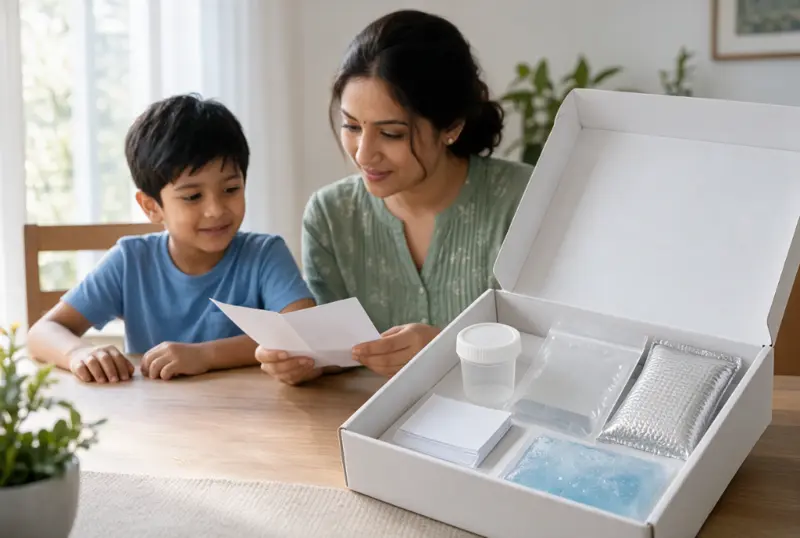
Collect the first urine of the morning on an empty stomach, before eating or drinking, about 20 mL. Our team goes through the preparation with you on a call before the collection.
Should I stop supplements or medicines before the test?
Do not stop any prescribed medicine, including antibiotics or antifungals, on your own. Some supplements are usually paused before collection: probiotics and high-dose B vitamins (B6, B12, folate) for about 5 days, and arabinogalactan, reishi, echinacea and ribose for 48 hours. Ask the doctor who advised the test which supplements to pause, and our team confirms the list with you on the call before collection.
How is the sample sent to the lab? Does it need to stay cold?
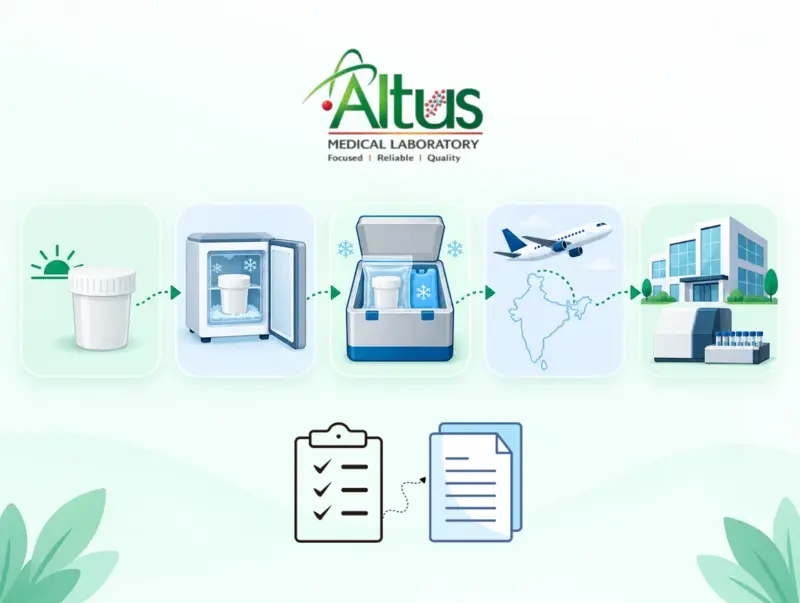
Yes, urine for organic acid testing must stay frozen. After collection, the sample is frozen and air-lifted to Altus Reference Lab, Chandigarh, in temperature-controlled packaging with ice packs, so the markers stay stable until testing.
How long does the report take, and how will I get it?
The Advanced OAT report is usually ready within 14 days of sample collection, and the OAT report within 7 days. This includes the time needed to transport your sample to our reference lab in Chandigarh. You receive the report as a PDF on WhatsApp and by email.
Can I get the OAT test done in my city?
Yes. We arrange sample collection in all 28 states and in the union territories, including Delhi NCR, Bengaluru, Mumbai, Hyderabad, Chennai, Kolkata and Pune. In a few remote areas, such as Lakshadweep, the Andaman and Nicobar Islands and Ladakh, collection is on request, so please call us to confirm for your location.
Can the OAT and FRAT tests be done together?
They are separate tests and are booked separately. Doctors sometimes advise both when evaluating a child with autism or suspected cerebral folate deficiency, and both are included in our Autism Diagnostic Panel. If your doctor has advised both, tell our team when you book and we will plan the collection with you, so both samples can be arranged as conveniently as possible.
Which doctor should I consult after getting the report?
Share the report with the doctor who advised the test. If no doctor advised it, consult a functional medicine doctor or a neurologist, who can read the results together with your history, symptoms and other tests.
Is the OAT the same as a routine urine test?
No. A routine urine test checks for infection, sugar, protein and blood, mainly to look at the kidneys and urinary tract. The OAT and Advanced OAT measure by-products of metabolism in urine, using mass spectrometry, to look at energy production, gut microbial activity, nutrient status and other pathways.
Is the OAT the same as a gut microbiome test?
No. A gut microbiome test analyses a stool sample to identify the bacteria in the gut. The OAT uses urine and measures by-products that some gut microbes make, along with many markers of metabolism, so it gives an indirect view of gut microbial activity rather than a list of species.
How do I book, and when do I pay?
Tap Book, call +91 628 421 4977 or message us on WhatsApp. Our team confirms your test, explains the preparation and schedules collection at your address. Payment details are shared by our team when your booking is confirmed.