Autoimmune & Demyelinating Neurology Tests in Chandigarh
When the Immune System Attacks the Nervous System
Neurological symptoms rarely arrive with an obvious cause. Sudden vision loss, limb weakness, double vision, or unexplained paralysis can stem from dozens of conditions, and many of the most treatable ones happen when the immune system mistakenly attacks the brain, spinal cord, or nerves.
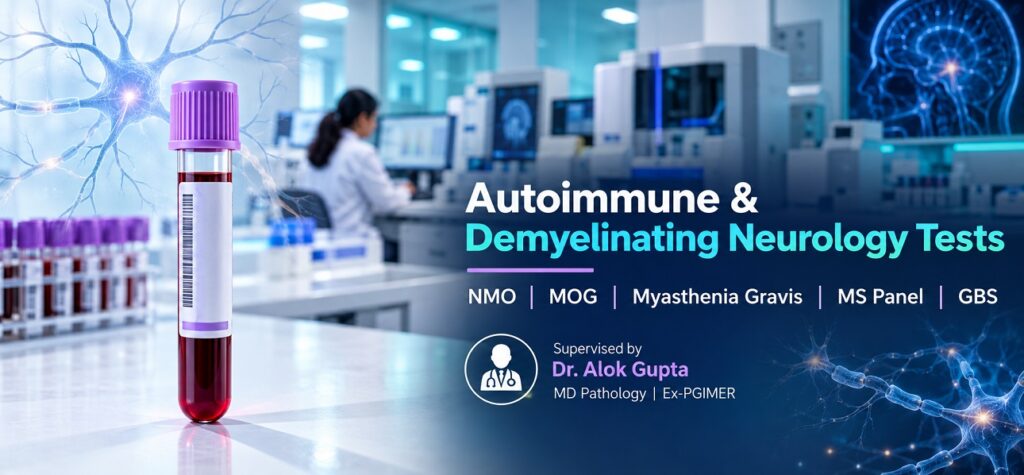
This guide covers the autoimmune and demyelinating panel Altus Lab offers, covering conditions like NMO spectrum disorder, multiple sclerosis, myasthenia gravis, and Guillain-Barré syndrome. Each test here helps your neurologist identify a specific antibody-driven mechanism, often opening the door to targeted treatment rather than guesswork.
Dr. Alok Gupta, MD Pathology, Ex-PGIMER Chandigarh, supervises every test, with home sample collection available across Chandigarh, Mohali, and Panchkula. For infectious, genetic, and metabolic neurology tests, read our companion guide covering that separate category.
Aquaporin-4 IgG (NMO IgG) – NMO Test Chandigarh
Aquaporin-4 IgG, commonly called NMO IgG, detects antibodies against a water channel protein found on cells surrounding the optic nerves and spinal cord. When present, these antibodies drive Neuromyelitis Optica Spectrum Disorder, a condition that can cause severe vision loss and spinal cord damage if misdiagnosed as multiple sclerosis.
This distinction matters enormously, since NMOSD and MS require very different treatments, and medications used for MS can actually worsen NMOSD. Consequently, doctors order this test urgently whenever a patient presents with severe optic neuritis or long-segment spinal cord inflammation, patterns that differ from typical MS presentations.
At Altus Lab, we understand that a delayed or incorrect diagnosis here can lead to irreversible disability. Our team prioritises rapid processing for NMO IgG testing, ensuring your neurologist gets the clarity needed to start the correct treatment pathway without unnecessary delay.
Anti-MOG Antibodies IgG
Anti-MOG Antibodies target Myelin Oligodendrocyte Glycoprotein, a protein on the protective myelin sheath covering nerve fibres. When positive, this test identifies MOG Antibody Disease, a distinct condition that overlaps clinically with both NMO and MS, yet requires its own specific treatment approach and carries a notably different long-term outlook.
Doctors typically order this test alongside Aquaporin-4 IgG whenever a patient presents with optic neuritis, transverse myelitis, or brainstem symptoms, since distinguishing between these three related conditions, NMOSD, MOG disease, and MS, directly determines which medications will help and which might cause harm.
Unlike NMOSD, MOG Antibody Disease often responds well to steroids and frequently has a better relapse-recovery pattern. At Altus Lab, accurate MOG antibody testing gives your neurologist the confidence needed to set realistic expectations and choose the treatment most likely to prevent future relapses.
NMOSD Panel (NMO + MOG Combined)
Rather than ordering Aquaporin-4 IgG and Anti-MOG antibodies separately, many neurologists prefer the combined NMOSD Panel, which tests for both markers together from a single sample. This approach makes clinical sense, since these two conditions frequently present with overlapping symptoms yet require careful distinction for accurate treatment planning.
This combined panel proves particularly valuable when a patient’s clinical picture doesn’t clearly point toward one condition over the other, which happens more often than textbook descriptions suggest. Testing both markers simultaneously also saves valuable time during an acute presentation, when starting the correct treatment quickly can meaningfully affect long-term outcomes.
At Altus Lab, we recommend this combined panel as the practical first step for any patient presenting with optic neuritis or myelitis of unclear cause, rather than testing one marker, waiting for results, and then ordering the second test separately.
Ganglioside Panel IgG – GBS Test Chandigarh
The Ganglioside Panel detects antibodies against gangliosides, specialised molecules found on peripheral nerve surfaces. This panel plays a central role in diagnosing Guillain-Barré Syndrome, an acute condition where the immune system attacks peripheral nerves, often following a recent infection, causing rapidly progressive weakness that can become life-threatening within days.
Because GBS can progress to respiratory failure quickly, doctors order this panel urgently alongside clinical assessment whenever a patient presents with ascending weakness, particularly after a recent gastrointestinal or respiratory illness. Different antibody patterns within this panel also help distinguish between GBS subtypes, which can influence prognosis and treatment response.
At Altus Lab, we recognise that GBS represents a genuine medical emergency. While treatment decisions are typically made on clinical grounds without waiting for results, this panel provides valuable confirmatory evidence and helps guide ongoing management as the patient’s condition evolves.
Paraneoplastic Panel – Chandigarh
The Paraneoplastic Panel detects antibodies associated with paraneoplastic neurological syndromes, rare conditions where the immune system’s response to an underlying cancer mistakenly attacks the nervous system. These syndromes can cause a wide range of symptoms, including memory loss, seizures, movement disorders, and muscle weakness, often appearing before the cancer itself is diagnosed.
This test becomes particularly important because paraneoplastic syndromes frequently serve as the first clinical clue leading to cancer detection, sometimes months before imaging reveals the underlying tumour. Consequently, a positive result on this panel often prompts a thorough cancer screening, even when no malignancy has been previously suspected.
At Altus Lab, we process this comprehensive panel for patients with unexplained, rapidly progressive neurological symptoms that don’t fit typical patterns, giving neurologists and oncologists a crucial diagnostic lead when the underlying cause remains genuinely unclear.
Autoimmune Encephalitis Panel (NMDA + VGKC)
Autoimmune Encephalitis occurs when the immune system attacks brain tissue directly, causing a dramatic combination of psychiatric symptoms, seizures, memory problems, and altered consciousness that can be easily mistaken for primary psychiatric illness. This panel tests for NMDA receptor antibodies and VGKC complex antibodies, two of the most clinically significant and treatable causes.
Doctors increasingly recognise this condition, since patients, often young and previously healthy, can develop severe symptoms rapidly, sometimes requiring intensive care. Critically, unlike many neurological conditions, autoimmune encephalitis often responds dramatically well to immunotherapy once correctly identified, making accurate testing genuinely life-changing rather than simply diagnostic.
At Altus Lab, we recommend this panel whenever a patient presents with new-onset psychiatric symptoms combined with seizures or neurological signs, particularly in young adults, since ruling out this treatable cause before assuming a purely psychiatric diagnosis can dramatically change the treatment path and outcome.
AChR Antibodies – Myasthenia Gravis Test Chandigarh
Acetylcholine Receptor, or AChR, Antibodies are the primary diagnostic marker for Myasthenia Gravis, a condition where the immune system attacks the connection between nerves and muscles, causing fluctuating weakness that typically worsens with activity and improves with rest. This pattern, weakness that changes throughout the day, is a hallmark clinical clue.
This test detects antibodies in approximately 85 percent of patients with generalised myasthenia gravis, making it the first-line test whenever a doctor suspects this condition based on symptoms like drooping eyelids, double vision, difficulty swallowing, or general fatigue that worsens through the day.
At Altus Lab, AChR antibody testing gives your neurologist the confirmation needed to start appropriate treatment, which often dramatically improves quality of life once correctly diagnosed. For patients who test negative despite strong clinical suspicion, we recommend proceeding to Anti-MuSK antibody testing next.
Anti-MuSK Antibodies – Myasthenia Gravis
Anti-MuSK Antibodies target Muscle-Specific Kinase, a different protein involved in the same nerve-muscle connection affected in myasthenia gravis. This test becomes essential specifically for the subset of patients who show classic myasthenia gravis symptoms yet test negative for AChR antibodies, since MuSK antibodies account for a meaningful portion of these otherwise unexplained cases.
Interestingly, MuSK-positive myasthenia gravis often presents somewhat differently, frequently affecting facial, neck, and breathing muscles more prominently than limb muscles, and can respond differently to standard treatments compared to AChR-positive disease. Recognising this distinction directly influences which therapies your neurologist will consider first.
At Altus Lab, we recommend Anti-MuSK testing as the natural next step whenever AChR antibody results come back negative despite a clinical picture strongly suggesting myasthenia gravis, ensuring patients don’t fall through a diagnostic gap simply because the first test came back normal.
Ocular Myasthenia Panel (AChR + MuSK)
The Ocular Myasthenia Panel combines both AChR and MuSK antibody testing specifically for patients whose symptoms remain limited to the eyes, including drooping eyelids and double vision that fluctuates through the day. This presentation, called ocular myasthenia gravis, can either stay confined to the eyes or eventually progress to affect other muscles throughout the body.
Testing both antibodies together makes particular sense here, since ocular-only presentations can sometimes show different antibody patterns compared to generalised disease, and catching the correct diagnosis early allows doctors to monitor closely for potential progression while starting appropriate treatment promptly.
At Altus Lab, we recommend this combined panel for any patient presenting with isolated eyelid drooping or double vision that varies throughout the day, since distinguishing ocular myasthenia gravis from other causes of these symptoms significantly changes both treatment and long-term monitoring plans.
Multiple Sclerosis Panel – MS Test Chandigarh
Diagnosing Multiple Sclerosis genuinely requires more than a single blood test. Our MS Panel combines several complementary markers designed to support your neurologist’s clinical assessment and MRI findings, since no single test can diagnose MS in isolation, but the right combination of results provides crucial supporting evidence.
This panel typically works alongside CSF Oligoclonal Bands and the CSF IgG Index, discussed next, since these three results together give neurologists the strongest possible laboratory evidence supporting an MS diagnosis, helping distinguish it from other conditions that can mimic MS symptoms, including NMOSD and MOG disease.
At Altus Lab, we understand that receiving an MS diagnosis represents a significant, often frightening, moment for patients and families. Consequently, we prioritise accuracy and rapid turnaround for this panel, recognising that clear answers, whether confirming or ruling out MS, genuinely matter for planning treatment and life ahead.
CSF Oligoclonal Bands (OCB) – Serum & CSF
CSF Oligoclonal Bands testing compares protein patterns between cerebrospinal fluid and blood serum, looking for bands present in CSF but absent in serum, a finding that indicates the immune system is producing antibodies specifically within the central nervous system rather than throughout the body generally.
This finding appears in over 90 percent of confirmed MS cases, making it one of the most valuable supporting tests available, though it requires a lumbar puncture to collect CSF alongside a blood sample. Doctors also use this test when investigating other inflammatory or infectious conditions affecting the central nervous system.
At Altus Lab, we process paired serum and CSF samples together for accurate comparison, since interpreting oligoclonal bands correctly absolutely requires examining both samples side by side. This careful, comparative approach ensures your neurologist receives genuinely meaningful results rather than an isolated, hard-to-interpret finding.
CSF IgG Index (Immunoglobulin Index)
The CSF IgG Index calculates the ratio of immunoglobulin production within the central nervous system compared to what normally crosses over from the blood, offering a numerical measure that complements the qualitative pattern seen in oligoclonal band testing. Together, these two tests provide complementary evidence of central nervous system inflammation.
An elevated IgG Index suggests the immune system is actively producing antibodies within the brain and spinal cord itself, a pattern strongly associated with MS and several other inflammatory neurological conditions. Because this index provides an objective number rather than a visual band pattern, some neurologists find it particularly useful for tracking disease activity over time.
At Altus Lab, we calculate this index alongside oligoclonal band testing whenever both are requested, since the combination gives significantly more diagnostic confidence than either test used alone, particularly in borderline or diagnostically challenging cases.
GAD-65 Antibodies – Stiff Person Syndrome Test
GAD-65 Antibodies target glutamic acid decarboxylase, an enzyme involved in producing a key neurotransmitter that regulates muscle relaxation. High levels of this antibody are strongly associated with Stiff Person Syndrome, a rare but genuinely disabling condition causing progressive muscle rigidity and painful spasms, often beginning in the trunk and legs.
This condition is frequently misdiagnosed initially, since progressive stiffness and spasms can resemble several other neurological and even psychiatric conditions. Consequently, GAD-65 testing becomes essential whenever a patient presents with unexplained, progressive muscle rigidity that doesn’t fit typical patterns, particularly when accompanied by painful spasms triggered by sudden movement or stress.
At Altus Lab, we recognise that reaching this diagnosis often takes patients through a long, frustrating journey. Accurate GAD-65 testing can finally provide answers, opening the door to immunotherapy treatments that can meaningfully improve symptoms once the correct underlying cause is identified.
Myositis Panel
The Myositis Panel tests for multiple autoantibodies associated with inflammatory muscle diseases, including dermatomyositis and polymyositis, conditions where the immune system attacks muscle tissue directly, causing progressive weakness, and sometimes affecting the lungs and skin alongside the muscles themselves.
This panel proves particularly valuable because different antibodies within it are associated with distinct clinical patterns, some linked to higher cancer risk requiring additional screening, others associated with specific lung involvement requiring pulmonary monitoring. Identifying the exact antibody present genuinely shapes the entire management plan going forward, not just the initial diagnosis.
At Altus Lab, we recommend this comprehensive panel whenever a patient presents with progressive proximal muscle weakness, particularly alongside skin changes or breathing difficulties, since the specific antibody pattern identified helps your rheumatologist or neurologist tailor both treatment and ongoing monitoring to your particular subtype of disease.
How to Book Autoimmune Neurology Testing at Altus Lab
Many of these tests require careful sample handling, and several work best when ordered together as part of a coordinated diagnostic panel. Call or WhatsApp our team, share your neurologist’s prescription, and we will confirm exactly which tests you need and coordinate sample collection accordingly.
📞 Call: 0172-5017001 / 0172-5017002
💬 WhatsApp: +91-62842-14977
📍 SCO 35, Sector 16-D, Chandigarh
🕐 Open 7 Days: 7:30 AM – 9:30 PM
Home sample collection is available for blood-based tests across Chandigarh, Mohali, and Panchkula. CSF-based tests require sample collection alongside your treating neurologist’s procedure.
Frequently Asked Questions
1. What is the difference between NMO and MOG antibody disease?
Both cause similar symptoms like optic neuritis and myelitis, but they are distinct conditions with different antibody targets, different treatment responses, and different long-term outlooks. Testing both helps your neurologist choose the right treatment path.
2. Why would I need both AChR and Anti-MuSK antibody testing?
Approximately 15 percent of myasthenia gravis patients test negative for AChR antibodies but positive for MuSK antibodies. Testing both ensures a correct diagnosis even when the first test comes back normal.
3. Is a lumbar puncture always required for MS testing?
CSF-based tests like Oligoclonal Bands and the IgG Index do require a lumbar puncture. However, your neurologist may use blood-based markers alongside MRI findings before deciding whether CSF testing is necessary.
4. How urgent is Ganglioside Panel testing for suspected GBS?
GBS can progress to respiratory failure within days, so clinical treatment often begins immediately based on symptoms alone, with laboratory testing providing important confirmatory and prognostic information alongside ongoing care.
5. Can the Paraneoplastic Panel detect cancer directly?
No. This panel detects antibodies associated with paraneoplastic syndromes, which can prompt further cancer screening, but it does not directly test for or diagnose cancer itself.
6. What symptoms suggest I should get the Autoimmune Encephalitis Panel?
New-onset psychiatric symptoms combined with seizures, memory problems, or altered consciousness, particularly in young adults, warrant this testing, since this often treatable condition can otherwise be mistaken for primary psychiatric illness.
7. Do I need to fast before these blood tests?
Most antibody panels require no fasting. However, always confirm specific preparation instructions with our team at the time of booking, since individual test combinations may vary.
8. Who reviews these test results at Altus Lab?
All autoimmune neurology panels are supervised by Dr. Alok Gupta, MD Pathology, Ex-PGIMER Chandigarh, ensuring accurate, clinically reviewed reporting for every patient.