Quick answer: heavy metal test blood vs urine
Neither sample is better for every case. Blood is the standard test for lead, urine is preferred for recent arsenic exposure, and for mercury and cadmium the choice depends on the likely source of exposure and the question your doctor is asking. Your doctor chooses the sample based on the metal and when exposure may have happened.
At Altus Lab, a NABL-accredited lab in Chandigarh, the heavy metal blood profile and urine screen are ₹8,500 each, home sample collection across India is included, and the report is ready in 2–5 working days after the sample reaches our lab.
- ₹8,500 · blood or urine
- Home collection included
- Collection across India
- Report in 2–5 working days
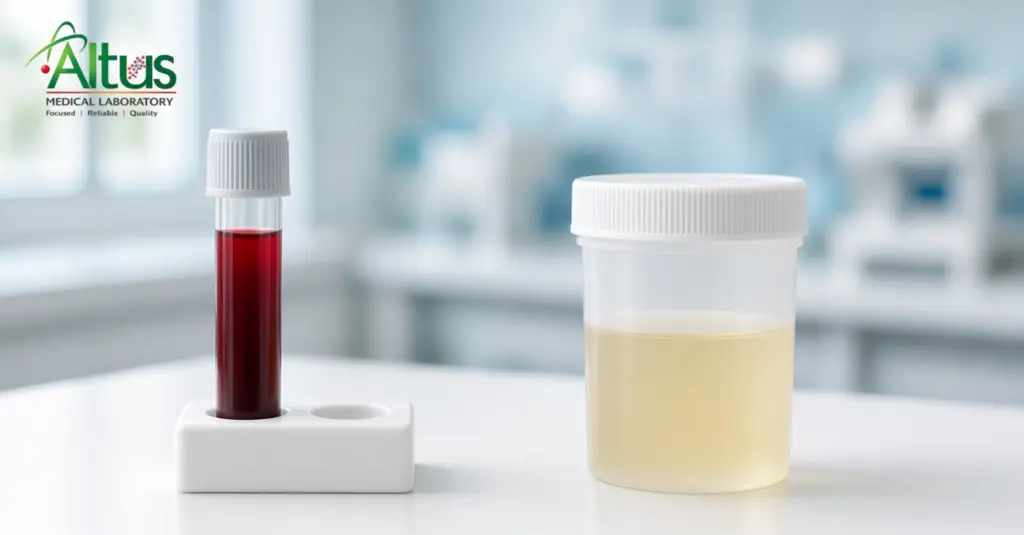
Blood and urine are the two samples doctors most often use to check for heavy metals, and each answers a different question. Public health guidance reflects this: the US Centers for Disease Control and Prevention (CDC) treats a blood test as the standard check for lead, while the US Agency for Toxic Substances and Disease Registry (ATSDR) describes urine as the most reliable test for arsenic exposure within the last few days. This guide, reviewed by our pathologist, explains what each sample can and cannot show, which sample is commonly used for lead, mercury, arsenic and cadmium, how a urine sample is collected and how to prepare, so you and your doctor can choose the right heavy metal test in India.
- What it is
- Blood vs urine
- Which sample for which metal
- Comparison table
- Results
- Preparation
- Cost
- Chandigarh & India
- FAQs
What is a heavy metal test, and why do doctors order it?
A heavy metal test measures selected metals, such as lead, mercury and arsenic, in a blood or urine sample. Doctors may order it to help assess possible exposure, for example from old paint, some industrial work, contaminated water, certain imported products or some traditional remedies. A test request does not mean something is wrong, and a result does not diagnose a condition on its own. Your doctor reads it together with your exposure history and clinical findings.
Heavy metal blood test vs heavy metal urine test: what each one shows
Heavy metal blood test
Measures selected metals in a blood sample. For many metals, blood mainly reflects recent or ongoing exposure, and levels can change fairly quickly after exposure stops.
- Standard sample for lead
- A simple blood draw, no timed collection
- One value is a snapshot, so doctors may repeat it if exposure continues
Heavy metal urine test
Measures selected metals passed out in urine. It is preferred for some metals, such as arsenic, and for cadmium it mainly reflects the amount built up in the body over time.
- Preferred sample for arsenic
- Recent seafood can raise arsenic results
- Not a “long-term” measure for every metal
Heavy metal urine test: random or 24-hour urine?
For screening, a random (spot) urine sample is widely used. It is collected in one go, so it does not add time before the sample can travel to the lab. A 24-hour urine collection can give a more consistent measure for some metals, but it takes a full extra day, needs a larger metal-free container, and is easy to collect incompletely, so it is usually done when the doctor specifically asks for it. If your prescription says “24-hour urine”, tell us when you book.
Which sample is commonly used for which metal?
Tap the metal your doctor is checking:
Lead
Blood: standard test
A blood lead test is the standard way to check for lead exposure, and it is what the CDC describes as the best way to find out whether a child has lead poisoning.
Source: CDC
Mercury
BloodUrine
Mercury can be measured in blood or urine (and also in hair or toenails). The test cannot tell which form of mercury you were exposed to, so your doctor chooses the sample based on the likely source, such as fish in the diet, some industrial work or certain products.
Source: ATSDR (US Agency for Toxic Substances and Disease Registry)
Arsenic
Urine: preferred
Urine is the most reliable test for arsenic exposure within the last few days. Fish and shellfish contain arsenic mostly in a much less harmful organic form, which can still raise total urine arsenic if eaten shortly before collection.
Source: ATSDR
Cadmium
Blood: recent exposureUrine: body burden over time
Blood cadmium indicates more recent exposure, while urine cadmium is the best estimate of the total amount built up in the body. Your doctor picks the sample based on which question matters.
Source: ATSDR
Heavy metal test blood vs urine: side-by-side comparison
Swipe the table sideways to see both columns →
| Feature | Heavy metal blood test | Heavy metal urine test |
|---|---|---|
| Sample | Blood draw | Random (spot) urine; 24-hour only if the doctor asks |
| Commonly used for | Lead; mercury; recent cadmium exposure | Recent arsenic exposure; mercury; cadmium body burden |
| Mainly reflects | Recent or ongoing exposure, for most metals | Recent exposure for some metals; build-up over time for cadmium |
| Things that affect results | Timing since exposure | Recent seafood (arsenic), urine concentration, collection method |
| At Altus Lab | ₹8,500, home collection included | ₹8,500, home collection included |
| Report | 2–5 working days from sample receipt | 2–5 working days from sample receipt |
Blood and urine tests are not interchangeable. The right sample depends on the metal, the suspected exposure and your doctor’s clinical assessment. Hair analysis is a separate test with its own uses; ask your doctor whether it suits your question.
Before you book: 4 questions to ask your doctor
- Which metal or metals are being checked?
- Should the sample be blood or urine?
- For urine, is a random sample fine, or do you need a 24-hour collection?
- Are there any preparation instructions, such as avoiding seafood?
How are heavy metal blood test and urine test results interpreted?
A result is read in the context of the specific metal, the sample type, your exposure history and clinical findings. The same number can mean different things depending on these factors, so a single lab value should not be used to make a diagnosis. Your doctor decides whether further assessment or a repeat test is needed.
How to prepare for a heavy metal test in India
- Blood test: no special fasting is generally required.
- Urine test: laboratories commonly advise avoiding seafood for 48–72 hours before collection, because it can raise arsenic results.
- Recent CT or MRI with contrast dye: laboratories commonly advise waiting 3–4 days after iodine or gadolinium contrast before giving a sample for metal testing. Tell us if you had a scan recently.
- Medicines and supplements: do not stop prescribed medicines or supplements unless your doctor advises it.
The Altus team confirms the instructions for your specific test when you book.
How it works with Altus Lab
- Book on WhatsAppShare your doctor’s advice and your city.
- Home collectionSample collected at your home, anywhere in India. Included in the price.
- Sent to our Chandigarh labProcessed at Altus Reference Lab, Chandigarh.
- Report in 2–5 working daysCounted from the day the sample reaches our lab.
Heavy metal test in India: what it costs at Altus Lab
Heavy Metals Profile (Blood)
₹8,500
Home collection included, across India
Report in 2–5 working days from sample receipt
Heavy Metals Screen (Urine)
₹8,500
Home collection included, across India
Report in 2–5 working days from sample receipt
If your doctor has asked for one metal only, single-metal tests are also listed on our homepage, for example Lead (Blood) ₹2,000 and Mercury ₹2,000. When comparing heavy metal test prices in India, check which metals are included, which sample is used, and whether home collection is part of the price.
Heavy metal test in Chandigarh and across India
In Chandigarh, Mohali, Panchkula, Zirakpur or Kharar
Visit Altus Lab at SCO 35, Sector 16-D, Chandigarh 160015, open 7:30 AM to 9:30 PM, every day, or book home sample collection anywhere in the Tricity: Chandigarh, Mohali, Panchkula, Zirakpur and Kharar.
Call 0172-5017001 or WhatsApp +91 628 421 4977.
Anywhere else in India
We arrange home sample collection in your city, for example in Delhi NCR, Mumbai, Pune, Bengaluru, Hyderabad, Chennai, Kolkata, Ahmedabad, Jaipur or Lucknow. The sample is processed at Altus Reference Lab, Chandigarh, and home collection is included in the ₹8,500 price.
Share your city on WhatsApp and we confirm your collection slot.
How to choose a lab for a heavy metal test in Chandigarh or anywhere in India
When people look for a good lab for a specialty test like this, these are the points worth checking. Here is how Altus Lab compares on each.
| What to check | Why it matters | At Altus Lab |
|---|---|---|
| NABL accreditation | The lab’s quality system is independently assessed | NABL accredited, Certificate No. M-0828 |
| Pathologist oversight | A qualified doctor is responsible for the reports | Led by Dr. Alok Gupta, MD Pathology, Ex-PGIMER, Chandigarh |
| Clear, all-in price | No surprise charges after booking | ₹8,500 for blood or urine, home collection included |
| Stated report time | You can plan your doctor’s visit | 2–5 working days from sample receipt |
| Report acceptance | Your doctor or hospital can use the report | Reports accepted at PGI, AIIMS, GMCH and major hospitals |
| Track record and reviews | Real feedback from patients and doctors | Founded in 2013; 330+ physicians refer patients; read our Google reviews |
| Reach | You shouldn’t have to travel for a specialty test | Lab in Sector 16-D, Chandigarh, with sample collection across India |
Frequently asked questions
Heavy metal test blood vs urine: which is better?
Neither is better for every case. Blood is the standard test for lead, urine is preferred for arsenic, and for mercury and cadmium it depends on the likely source of exposure and whether your doctor wants recent exposure or a longer-term picture. Your doctor should decide which sample is appropriate.
How much is a heavy metal test in India at Altus Lab?
At Altus Lab, the heavy metal blood profile and the heavy metal urine screen are ₹8,500 each. Home sample collection across India is included in the price.
How long does the heavy metal test report take?
The report is ready in 2–5 working days after the sample reaches the Altus Lab in Chandigarh.
For a heavy metal urine test, is random or 24-hour urine used?
A random (spot) urine sample is widely used for heavy metal screening and does not delay the test. A 24-hour urine collection is done only when the doctor specifically asks for it.
Where can I get a heavy metal test in Chandigarh?
Altus Lab, a NABL-accredited lab at SCO 35, Sector 16-D, Chandigarh 160015, offers the heavy metal blood and urine tests at ₹8,500 each. The lab is open 7:30 AM to 9:30 PM every day, and home sample collection is available across Chandigarh, Mohali, Panchkula, Zirakpur and Kharar, as well as the rest of India.
Do I need to fast for a heavy metal blood test?
No special fasting is generally required for the heavy metal blood test. For a urine test, laboratories commonly advise avoiding seafood for 48–72 hours before collection. The Altus team confirms the instructions for your test when you book.
Can a heavy metal test diagnose poisoning?
No. A heavy metal test result alone does not establish a diagnosis. A doctor interprets the result together with the person’s exposure history, symptoms and other clinical findings.
Ready to book your heavy metal test?
Confirm with your doctor which metal and which sample you need, then message us. We arrange home collection in your city, and the ₹8,500 price includes it. In the Tricity, you can also visit us at SCO 35, Sector 16-D, Chandigarh, 7:30 AM to 9:30 PM every day.

Dr. Alok Gupta, MD Pathology, Ex-PGIMER, Chandigarh
Dr. Alok Gupta leads Altus Lab, a NABL-accredited lab in Sector 16-D, Chandigarh, founded in 2013, with sample collection across India for specialty tests.
Medically reviewed:
References
- Centers for Disease Control and Prevention. Testing for lead in children. cdc.gov
- Agency for Toxic Substances and Disease Registry. ToxFAQs: Mercury. atsdr.cdc.gov
- Agency for Toxic Substances and Disease Registry. ToxFAQs: Arsenic. atsdr.cdc.gov
- Agency for Toxic Substances and Disease Registry. ToxFAQs: Cadmium. atsdr.cdc.gov
- American College of Medical Toxicology. Position statement on post-chelator challenge urinary metal testing. J Med Toxicol. 2010;6(1):74–75. PMC
This page gives information about laboratory tests and is not medical advice. Please consult your doctor.