
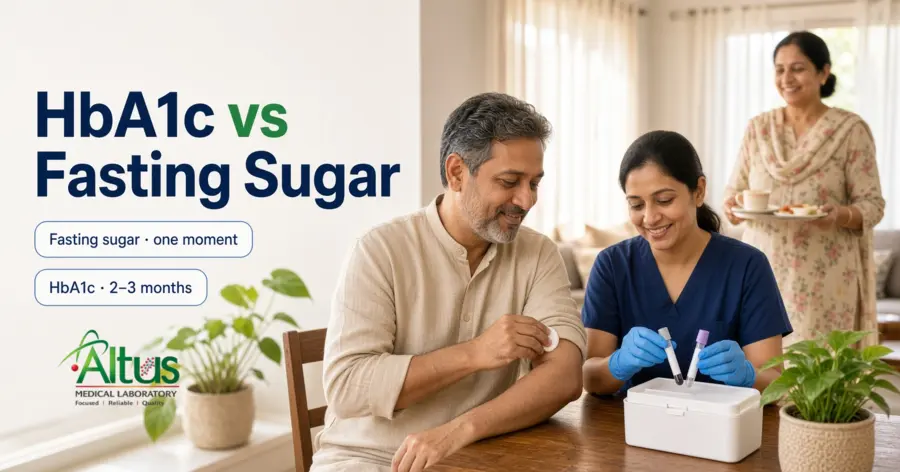
You open your report and one number looks fine while the other is flagged. Or your doctor writes “HbA1c and FBS” on the prescription, and you wonder whether one test is enough. This is a common question when comparing diabetes blood tests.
HbA1c vs fasting sugar: the quick answer
The short answer: HbA1c reflects your average blood glucose over approximately the past 2–3 months, while a fasting blood sugar (FBS) test measures glucose at a single point in time after at least eight hours without food. Both tests provide different information, and doctors may recommend one or both depending on a person’s health and medical history.
At Altus Lab, the FBS test costs ₹50 and the HbA1c test costs ₹500.
- NABL accredited
- Same-day reports for most routine tests
- Home collection across the Tricity
- Open 7:30 AM – 9:30 PM daily
What Is a Fasting Blood Sugar Test (FBS)?
A fasting blood sugar test, also called a fasting glucose test, measures the glucose level in your blood after you have not eaten for at least eight hours. The result gives your doctor a fasting glucose reading at that point in time.
FBS is commonly used as part of diabetes screening and assessment. However, blood glucose levels can vary due to factors such as stress and illness. Therefore, a single reading may not provide the complete picture of your blood glucose levels. Your doctor may recommend repeat testing or another blood glucose test depending on the result and your health history.
What Is the HbA1c Test?
The HbA1c test measures the percentage of haemoglobin in your red blood cells that has glucose attached to it. Since red blood cells typically live for about 120 days, the result provides an estimate of your average blood glucose over approximately the past 2–3 months.
Unlike a fasting blood sugar test, HbA1c does not measure glucose at just one moment. It helps doctors understand longer-term blood glucose patterns and may also be used to monitor diabetes management over time.
Certain conditions, including some types of anaemia, haemoglobin variants and recent blood loss or transfusion, can affect HbA1c results. Your doctor should consider these factors when interpreting the report.
HbA1c vs Fasting Blood Sugar: Key Differences
Now that both tests are clear, the difference between HbA1c and FBS comes down to time, preparation and what each can miss. HbA1c vs FBS is not a contest, because each test fills a gap the other leaves.
| Comparison point | Fasting blood sugar (FBS) | HbA1c test |
|---|---|---|
| What it measures | Blood glucose at one point in time | Average blood glucose over approximately 2–3 months |
| Fasting required? | Yes, at least 8 hours | Usually not required |
| Sample | Blood sample | Blood sample |
| Main use | Fasting glucose assessment | Longer-term blood glucose assessment |
| Report time at Altus Lab | Same day for most routine tests, often within 4–6 hours | Same day for most routine tests, often within 4–6 hours |
| Price at Altus Lab | ₹50 | ₹500 |
Swipe the table sideways to see both tests →
HbA1c Normal Range and Fasting Blood Sugar Normal Range
Doctors compare HbA1c and fasting blood sugar results with established clinical reference ranges. The following cut-offs are based on American Diabetes Association (ADA) criteria for non-pregnant adults.
For HbA1c, a result below 5.7% is considered within the normal range, 5.7–6.4% falls in the prediabetes range, and 6.5% or higher falls in the diabetes range.
For fasting plasma glucose, below 100 mg/dL is considered within the normal range, 100–125 mg/dL falls in the prediabetes range, and 126 mg/dL or higher falls in the diabetes range.
| Category | HbA1c | Fasting plasma glucose |
|---|---|---|
| Normal range | Below 5.7% | Below 100 mg/dL |
| Prediabetes range | 5.7–6.4% | 100–125 mg/dL |
| Diabetes range | 6.5% or higher | 126 mg/dL or higher |
WHO defines impaired fasting glucose as 110–125 mg/dL. Without clear symptoms, a result in the diabetes range is usually confirmed with a repeat or second test. Your doctor interprets the report.
The World Health Organization (WHO) uses a different lower threshold for impaired fasting glucose. Therefore, reference ranges and clinical guidelines should be considered when interpreting results.
In people without clear symptoms, an abnormal result generally needs confirmation through repeat testing or another accepted test. Your doctor will interpret the result alongside your symptoms, medical history and other relevant findings.
Does the HbA1c Test Require Fasting? How Many Hours for FBS?
The HbA1c test usually does not require fasting because it measures average blood glucose over a longer period rather than glucose at a single point in time.
A fasting blood sugar test generally requires at least eight hours without food. Plain water is usually permitted during this period. If your doctor orders both HbA1c and FBS together, you will need to follow the fasting instructions for FBS.
Always follow the preparation instructions provided by your doctor or the laboratory before giving your sample.
Can HbA1c Be High When Fasting Sugar Is Normal?
Yes, HbA1c and fasting blood sugar results can sometimes fall into different ranges because the two tests measure different aspects of blood glucose.
Fasting blood sugar measures glucose after an overnight fast, whereas HbA1c reflects average blood glucose over approximately 2–3 months. Blood glucose can vary at different times of the day, so the results may not always show the same pattern.
Certain conditions, including anaemia, some haemoglobin variants and changes in red blood cell turnover, can also affect HbA1c results.
If your HbA1c and fasting blood sugar results do not match, do not ignore either result or try to interpret the difference on your own. Discuss the reports with your doctor, who can decide whether repeat testing or further assessment is appropriate.
Is HbA1c Better Than Fasting Blood Sugar?
Neither test is better in every situation. HbA1c provides information about average blood glucose over approximately 2–3 months, while fasting blood sugar measures glucose after an overnight fast.
HbA1c is convenient because fasting is usually not required, but certain conditions, such as anaemia and some haemoglobin variants, can affect its reliability. Fasting blood sugar is a useful measurement, but it represents glucose at one particular point in time.
Your doctor may consider your symptoms, medical history, risk factors and previous test results before deciding which test, or combination of tests, is appropriate.
FBS and PPBS Difference: Where Does Post-Meal Sugar Fit In?
You may also see PPBS mentioned on a prescription. FBS stands for fasting blood sugar, which is measured after an overnight fast. PPBS stands for post-prandial blood sugar, which measures blood glucose after a meal at the time specified by the doctor or laboratory.
These tests measure blood glucose at different times. Your doctor may recommend FBS, PPBS, HbA1c or a combination depending on the clinical reason for testing.
When Do Doctors Recommend Both HbA1c and FBS Tests?
Doctors may recommend both HbA1c and fasting blood sugar when they need information about different aspects of blood glucose. For example, they may consider both tests when an earlier result is borderline, when results do not match, or when assessing blood glucose management over time.
The choice depends on the person’s symptoms, medical history, risk factors and previous reports. Your doctor will decide whether one test is sufficient or whether additional testing is appropriate.
Where to Get a Diabetes Test in Chandigarh and Mohali
If you are looking for the best medical laboratory in Chandigarh or Mohali for routine blood tests, it is useful to understand the test requirements, sample collection options and report turnaround before booking.
Altus Lab is a trusted NABL-accredited lab in Chandigarh with sample collection across India for specialty tests. Patients looking for a medical lab in Chandigarh or a pathology laboratory in Chandigarh can enquire about available routine testing options.
If you need an HbA1c test in Chandigarh or an FBS test in Chandigarh, the confirmed prices at Altus Lab are ₹500 and ₹50, respectively.
Same-day reports are available for most routine tests, often within 4–6 hours. Home sample collection is available across Chandigarh, Mohali, Panchkula, Zirakpur and Kharar. Home collection is charged.
You can explore the diabetes testing options in Chandigarh or visit the Altus Lab for booking and home sample collection information.
Book an HbA1c or fasting sugar test at Altus Lab, Chandigarh
Altus Medical Laboratories & Diagnostic Center (Altus Lab)
SCO 35, Sector 16-D, Chandigarh 160015
HbA1c test price in Chandigarh: ₹500 · FBS test price in Chandigarh: ₹50
Open: 7:30 AM – 9:30 PM, every day
Phone: 0172-5017001 · Mobile / WhatsApp: +91 628 421 4977
Get directions to the lab on Google Maps
Sugar test at home in Chandigarh and nearby (home collection is charged):
- Chandigarh
- Mohali
- Panchkula
- Zirakpur
- Kharar
Send the test name and your area on WhatsApp and the team will confirm a collection slot.
- NABLAccredited lab (Certificate M-0828)
- 2013Founded in Chandigarh
- MD PathologyLed by Dr. Alok Gupta, Ex-PGIMER
- PGI · AIIMS · GMCHReports accepted at PGI, AIIMS, GMCH and major hospitals
- 330+Physicians refer patients
Frequently Asked Questions
What is the difference between FBS and HbA1c?
FBS measures blood glucose at a particular point in time after fasting for at least eight hours. HbA1c estimates average blood glucose over approximately 2–3 months.
Can fasting blood sugar detect diabetes?
Fasting blood glucose can show a result within the diabetes range. However, in people without clear symptoms, an abnormal result generally needs confirmation through repeat testing or another accepted test. A doctor should interpret the result.
Does the HbA1c test require fasting?
Usually not. FBS needs at least eight hours without food, so if both are ordered, you will fast for the FBS.
Is HbA1c better than fasting blood sugar?
Neither test is better in every situation. HbA1c reflects longer-term blood glucose patterns, while FBS measures glucose after fasting. Your doctor will decide which test is appropriate.
Why do HbA1c and fasting sugar results differ?
The tests measure different aspects of blood glucose. Factors such as variations in blood glucose throughout the day and certain conditions affecting red blood cells can contribute to differences. Discuss mismatched results with your doctor.
What is the HbA1c test price in Chandigarh?
At Altus Lab, Sector 16-D, Chandigarh, the HbA1c test price is ₹500 and the fasting blood sugar (FBS) test price is ₹50. Reports for most routine tests are ready the same day, often within 4–6 hours. Home sample collection is available across Chandigarh, Mohali, Panchkula, Zirakpur and Kharar for an extra charge.
How often should HbA1c be tested?
For people with diabetes whose glucose levels are stable and within the goal set with their doctor, the ADA suggests HbA1c testing at least twice a year. When treatment has changed or goals are not being met, testing about every three months is common. Your doctor will decide the right interval for you.
References
- American Diabetes Association Professional Practice Committee. 2. Diagnosis and Classification of Diabetes: Standards of Care in Diabetes—2026. Diabetes Care 2026;49(Suppl 1):S27–S49. doi:10.2337/dc26-S002
- American Diabetes Association Professional Practice Committee. 6. Glycemic Goals, Hypoglycemia, and Hyperglycemic Crises: Standards of Care in Diabetes—2026. Diabetes Care 2026;49(Suppl 1):S132–S149. doi:10.2337/dc26-S006
- World Health Organization, International Diabetes Federation. Definition and diagnosis of diabetes mellitus and intermediate hyperglycaemia. Geneva: WHO; 2006. who.int
This page gives information about laboratory tests and is not medical advice. Please consult your doctor.
Medically reviewed by Dr. Alok Gupta, MD Pathology, Ex-PGIMER, Chandigarh · Last reviewed 6 November 2026.