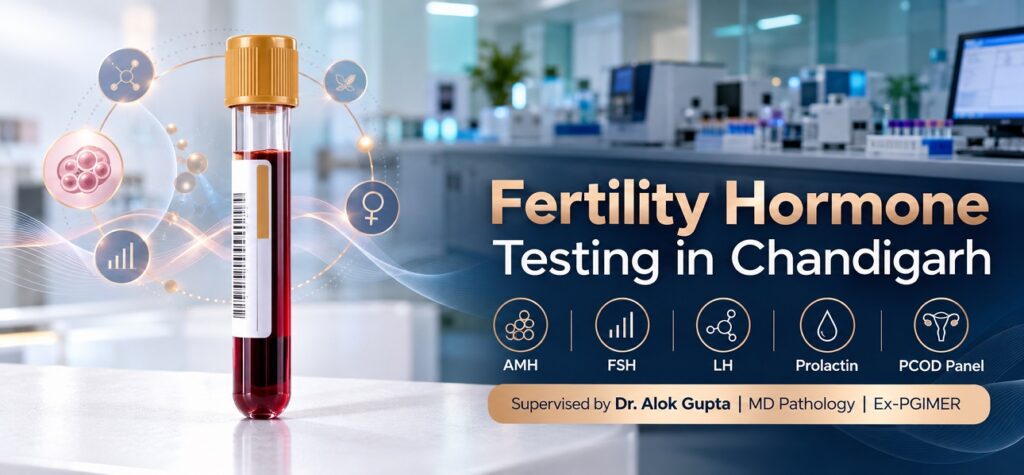
Fertility Hormone & Ovarian Reserve Testing in Chandigarh
Understanding Your Cycle Before You Understand Your Fertility
Fertility investigations often begin with a single question that has no simple answer: is everything working the way it should? Hormones drive nearly every stage of the reproductive cycle, and even small imbalances can affect ovulation, egg quality, and the ability to conceive, often without any obvious symptoms pointing to the cause.
This guide covers the hormonal and metabolic panel Altus Lab offers for fertility evaluation and PCOD workup. For recurrent pregnancy loss testing, male fertility analysis, genetic screening, and antenatal panels, read our companion guide covering that separate category.
Every test here is supervised by Dr. Alok Gupta, MD Pathology, Ex-PGIMER Chandigarh, with home sample collection available across Chandigarh, Mohali, and Panchkula.
FSH & LH (Day 2–3 of Cycle)
Follicle Stimulating Hormone and Luteinising Hormone are measured together on Day 2 or 3 of your menstrual cycle, offering a window into how your brain is signalling your ovaries at the very start of a new cycle, before follicle development begins in earnest.
FSH levels rise as ovarian reserve declines, since the brain compensates for fewer, less responsive follicles by producing more stimulating hormone. The LH to FSH ratio also provides valuable information, particularly for identifying PCOS, where this ratio is often elevated compared to typical cycle patterns.
At Altus Lab, we recommend timing this test precisely, since results outside the correct cycle window can be genuinely misleading. Our team provides clear guidance on cycle-day timing when you book, ensuring your fertility specialist receives results that accurately reflect your baseline hormonal status.
Estradiol (E2) – Day 2–3 & Mid-Cycle
Estradiol, the primary form of oestrogen during reproductive years, is tested at two distinct points for different reasons. Day 2 to 3 testing, alongside FSH, helps assess baseline ovarian function, while mid-cycle testing tracks the rise in estradiol that signals an approaching ovulation.
Baseline estradiol also helps doctors interpret FSH results accurately, since elevated estradiol early in the cycle can artificially suppress FSH, potentially masking declining ovarian reserve if estradiol is tested in isolation. This is precisely why doctors order both hormones together rather than separately.
At Altus Lab, we process Day 2-3 estradiol alongside FSH as a standard combined test, and offer mid-cycle testing separately for cycle monitoring during fertility treatment, giving your specialist accurate, correctly timed data at each distinct stage of your cycle.
Progesterone (Day 21 – Mid-Luteal)
Progesterone testing on Day 21, or more precisely during the mid-luteal phase for patients with irregular cycles, confirms whether ovulation has actually occurred that cycle. A significant rise in progesterone only happens after the ovary releases an egg, making this test a reliable, practical marker of ovulation.
This test becomes particularly important for patients trying to conceive with irregular or unpredictable cycles, since confirming ovulation, or identifying anovulatory cycles, directly shapes the next steps in fertility investigation and treatment. Low progesterone despite regular cycles can also suggest a luteal phase defect worth addressing.
At Altus Lab, we recommend adjusting the exact testing day based on your individual cycle length rather than rigidly following Day 21 for every patient, since accurate timing relative to ovulation matters far more than a fixed calendar date.
AMH (Anti-Müllerian Hormone)
AMH has become one of the most valued tests in modern fertility assessment, since it reflects ovarian reserve, the approximate number of remaining eggs, with reasonable stability throughout the menstrual cycle, unlike FSH and estradiol, which require precise cycle-day timing to interpret correctly.
This convenience makes AMH testing genuinely practical, since it can be performed on any day of the cycle. Low AMH suggests diminished ovarian reserve, useful information for planning fertility treatment timelines, while very high AMH often points toward PCOS, where numerous small follicles are typically present.
At Altus Lab, we also offer an expanded AMH Plus Panel for patients needing a more comprehensive ovarian reserve assessment alongside complementary markers, giving your fertility specialist a fuller picture when planning treatment approaches like IVF or fertility preservation.
Prolactin (PRL)
Prolactin, a hormone primarily associated with milk production, can interfere significantly with normal ovulation when elevated outside of pregnancy or breastfeeding, making this a standard test whenever irregular cycles, absent periods, or unexplained infertility are being investigated.
Elevated prolactin can stem from several causes, including certain medications, thyroid dysfunction, stress, or, less commonly, a small pituitary gland tumour called a prolactinoma. Identifying and treating the underlying cause often restores normal ovulation without requiring more invasive fertility interventions.
At Altus Lab, we recommend prolactin testing as a standard component of the initial fertility workup, particularly for patients with irregular or absent periods, since correcting an elevated prolactin level can sometimes resolve fertility challenges on its own, before other treatments are even considered.
Testosterone (Total & Free) & DHEAS
Testosterone and DHEAS testing measures androgens, hormones present in all women at lower levels than men, but which can become elevated in conditions like PCOS, causing symptoms including excess hair growth, acne, and irregular cycles, alongside contributing to fertility challenges.
Testing both total and free testosterone matters because free testosterone, the biologically active portion not bound to proteins, often correlates more closely with symptoms than total testosterone alone. DHEAS specifically reflects adrenal gland androgen production, helping distinguish ovarian from adrenal sources of excess androgens.
At Altus Lab, we recommend this combined panel for patients with symptoms of androgen excess or suspected PCOS, since identifying the specific pattern and source of elevated androgens helps your doctor choose the most appropriate treatment approach for your particular situation.
SHBG (Sex Hormone Binding Globulin) & Free Androgen Index
SHBG is a protein that binds testosterone in the bloodstream, and its level significantly influences how much free, biologically active testosterone is actually available to affect your body. Low SHBG, common in PCOS and insulin resistance, means more free testosterone circulates even when total testosterone appears normal.
The Free Androgen Index combines total testosterone and SHBG into a single calculated value, often providing a more clinically meaningful picture than either measurement alone, particularly useful when total testosterone results seem inconsistent with a patient’s actual symptoms of androgen excess.
At Altus Lab, we calculate this index automatically whenever SHBG and testosterone are tested together, giving your doctor immediate access to this valuable calculated value without requiring a separate request or additional sample collection.
Thyroid Panel (TSH, FT3, FT4, Anti-TPO)
Thyroid function affects fertility more significantly than many patients realise, since both underactive and overactive thyroid conditions can disrupt normal ovulation and menstrual regularity. This comprehensive panel tests TSH, Free T3, Free T4, and Anti-TPO antibodies together for a complete thyroid assessment.
Anti-TPO antibody testing deserves particular attention in fertility evaluation, since autoimmune thyroid disease can be present even when TSH, FT3, and FT4 all appear normal, and this underlying autoimmune activity has been associated with increased miscarriage risk in some studies.
At Altus Lab, we recommend this complete panel, rather than TSH alone, for anyone undergoing fertility evaluation, since thyroid dysfunction is both common and highly treatable, making it one of the most rewarding conditions to identify and correct during a fertility workup.
Insulin Resistance Panel (Fasting Insulin, HOMA-IR, Glucose)
Insulin resistance affects a significant proportion of women with PCOS, and this panel, combining fasting insulin, fasting glucose, and the calculated HOMA-IR value, helps identify this metabolic component even in patients who aren’t overweight, since insulin resistance can occur across all body types.
This distinction matters clinically, since addressing insulin resistance, whether through lifestyle changes or medication, often improves ovulation and cycle regularity independently of other PCOS treatments. Identifying this metabolic pattern also has long-term health implications beyond fertility, including diabetes risk.
At Altus Lab, we calculate the HOMA-IR value automatically from your fasting insulin and glucose results, giving your doctor a standardised, clinically validated measure of insulin resistance rather than requiring separate interpretation of two individual numbers.
PCOD Panel
Our comprehensive PCOD Panel combines several of the individual tests discussed above, including hormonal, androgen, and metabolic markers, into a single coordinated panel specifically designed for patients being evaluated for Polycystic Ovarian Disease, one of the most common causes of irregular cycles and fertility challenges.
Rather than ordering individual tests separately across multiple visits, this combined approach gives your doctor comprehensive information in one coordinated sample collection, covering the hormonal imbalances, androgen excess, and metabolic factors that together characterise this genuinely complex condition.
At Altus Lab, we designed this panel specifically for the initial PCOD workup, recognising that this condition rarely presents with a single abnormal marker, but rather a pattern across multiple related tests that together build your doctor’s diagnostic and treatment picture.
Inhibin B
Inhibin B, produced by developing ovarian follicles, offers another marker of ovarian reserve, sometimes used alongside AMH and FSH for a more complete assessment, particularly in specific fertility treatment planning scenarios where multiple complementary markers provide additional confidence.
While AMH has largely become the preferred first-line ovarian reserve marker due to its cycle-independent stability, Inhibin B still offers valuable supplementary information in certain clinical situations, particularly when results from other markers seem inconsistent with a patient’s clinical picture or age.
At Altus Lab, we offer Inhibin B testing as an additional marker when your fertility specialist requests a more comprehensive ovarian reserve assessment, working alongside AMH and FSH rather than replacing them, for situations requiring this additional layer of diagnostic information.
How to Book Fertility Hormone Testing at Altus Lab
Many of these tests require precise cycle-day timing, while others like AMH can be booked any day. Call or WhatsApp our team, share your doctor’s prescription, and we will confirm the correct timing for each test in your panel.
📞 Call: 0172-5017001 / 0172-5017002
💬 WhatsApp: +91-62842-14977
📍 SCO 35, Sector 16-D, Chandigarh
🕐 Open 7 Days: 7:30 AM – 9:30 PM
Home sample collection is available across Chandigarh, Mohali, and Panchkula.
Frequently Asked Questions
1. Why does FSH testing require a specific cycle day?
FSH levels naturally fluctuate throughout the cycle, and Day 2-3 testing reflects your true baseline ovarian function. Testing on other days can produce misleading results that don’t accurately represent ovarian reserve.
2. Is AMH testing really possible on any day of my cycle?
Yes. Unlike FSH and estradiol, AMH remains relatively stable throughout the menstrual cycle, making it convenient to test without precise cycle-day timing.
3. What does a high LH to FSH ratio suggest?
An elevated LH to FSH ratio is commonly associated with PCOS, though your doctor will interpret this alongside other hormonal and clinical findings for a complete picture.
4. Can thyroid problems really affect fertility if my periods seem regular?
Yes. Subtle thyroid dysfunction, including autoimmune thyroid antibodies, can affect fertility and pregnancy outcomes even when cycles appear outwardly regular.
5. Do I need to fast before the Insulin Resistance Panel?
Yes. Fasting insulin and fasting glucose both require an overnight fast, typically 8-12 hours, for accurate results.
6. Should I get the PCOD Panel or individual tests separately?
The combined panel is generally more efficient and cost-effective for initial PCOD evaluation, though your doctor may customise testing based on your specific symptoms and history.
7. How does Inhibin B differ from AMH testing?
Both assess ovarian reserve, but AMH has become the preferred primary marker due to its cycle-independent stability. Inhibin B is sometimes used as a supplementary marker in specific situations.
8. Who supervises these hormone tests at Altus Lab?
All fertility hormone panels are supervised by Dr. Alok Gupta, MD Pathology, Ex-PGIMER Chandigarh, ensuring accurate, clinically reviewed reporting for every patient.