Advanced OAT Test in India — Urine Metabolomics | 140+ Biomarkers | ₹18,000 | Altus Diagnostic
What Is the Advanced OAT Test?
Your blood reports are normal. Your thyroid is fine. Your haemoglobin is adequate. Yet you feel exhausted, mentally foggy, and physically unwell — and nobody can explain why. Or your child has been diagnosed with autism, ADHD, or a developmental delay, and you sense that something deeper is happening beneath the surface of that diagnosis. This is precisely the clinical gap that the Advanced OAT Test was designed to fill.
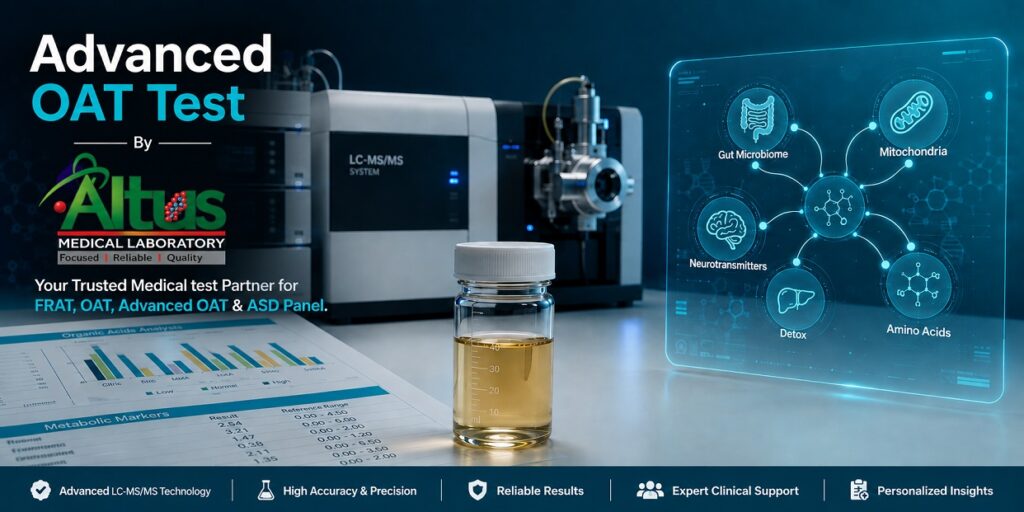
The Advanced Organic Acids Test (OAT) at Altus Diagnostic is a comprehensive urine metabolomics profile that generates a complete picture of how your body’s most critical biochemical systems are actually functioning at the cellular level. Using Liquid Chromatography–Tandem Mass Spectrometry (LC-MS/MS) — the gold standard in clinical metabolomics — the test simultaneously measures over 140 urinary organic acid biomarkers and calculates 21 functional ratio indices across nine distinct metabolic domains.
Organic acids are small-molecule metabolic byproducts excreted in urine. They are the chemical footprints left behind by enzymatic reactions taking place throughout your body — in your gut microbiome, your mitochondria, your liver detoxification pathways, your brain neurotransmitter synthesis, your vitamin metabolism, and your amino acid processing systems. When these footprints deviate from expected patterns, they reveal precisely where — and how seriously — the underlying biochemical machinery has broken down.
What the Advanced OAT Test Measures — 9 Clinical Domains
The Advanced OAT Test evaluates nine interconnected metabolic systems in a single urine sample. Its clinical power comes from seeing all nine simultaneously — revealing the relationships between gut dysbiosis and mitochondrial impairment, between neurotransmitter imbalances and B vitamin deficiencies, between glutathione depletion and oxidative DNA damage.
Complete Advanced OAT Test Marker List — 140+ Biomarkers
| Category | Markers [Count] | Biomarkers Measured |
|---|---|---|
| GUT MICROBIOME MARKERS | ||
| Yeast & Fungal | [9] | Citramalic acid · 5-Hydroxymethyl-2-Furoic acid (Aspergillus) · 3-Oxoglutaric acid · Furan-2,5-dicarboxylic acid (Aspergillus) · Furancarbonylglycine (Aspergillus) · Tartaric acid (Aspergillus) · Arabinose · Carboxycitric acid · Tricarballylic acid (Fusarium) |
| Bacterial Dysbiosis | [9] | Hippuric acid · Phenylacetic acid · 2-Hydroxyphenylacetic acid · 4-Hydroxybenzoic acid · Benzoic acid · Benzoylformic acid · DHPPA · Trimethylamine-N-Oxide (TMAO) · 4-Hydroxybenzoic acid isomer |
| Clostridia Species | [5] | 4-Hydroxyphenylacetic acid (C. difficile) · HPHPA (C. sporogenes, C. botulinum) · p-Cresyl sulfate (C. difficile) · 3-Indoleacetic acid (Clostridia spp.) · 3-Hydroxypropionic acid |
| Oxalate Metabolites | [3] | Glyceric acid · Glycolic acid · Oxalic acid |
| MITOCHONDRIAL & ENERGY MARKERS | ||
| Glycolytic Cycle | [2] | Lactic acid · Pyruvic acid |
| Krebs Cycle | [7] | Succinic acid · Fumaric acid · Malic acid · α-Ketoglutaric acid · Cis-aconitic acid · Citric acid · Isocitric acid |
| Mitochondrial Amino Acid & Redox | [7] | 3-Methylglutaric acid · 3-Methylglutaconic acid · 2-Hydroxyglutaric acid · 2-Methylglutaric acid · 3-Hydroxyglutaric acid · Succinylacetone · NAD+ (Nicotinamide adenine dinucleotide) |
| Ketone & Fatty Acid Oxidation | [9] | 3-Hydroxybutyric acid · Acetoacetic acid · Adipic acid · Suberic acid · Sebacic acid · Ethylmalonic + Methylsuccinic acid · Malonic acid · Tiglylglycine · 2-Pimelic acid |
| NEUROTRANSMITTER MARKERS | ||
| Catecholamines (Dopamine / Norepinephrine) | [5] | Vanilmandelic acid — VMA · Homovanillic acid — HVA · HVA/VMA Ratio · Dihydroxyphenylacetic acid — DOPAC · HVA/DOPAC Ratio |
| Serotonin & Kynurenine Pathway | [4] | 5-Hydroxyindole-3-acetic acid — 5-HIAA (serotonin) · 2,3-Pyridinedicarboxylic acid (Quinolinic acid) · Kynurenic acid · Picolinic acid |
| Folate-Dependent Pyrimidines | [2] | Uracil · Thymine |
| NUTRITIONAL MARKERS | ||
| Functional Vitamin Status | [10] | Methylmalonic acid — MMA (B12) · FIGLU (Folate) · Pyridoxic acid (B6) · Pantothenic acid (B5) · Glutaric acid · Ascorbic acid (Vitamin C) · 3-HMG (CoQ10 marker) · Mevalonic acid (Cholesterol biosynthesis) · N-Acetylcysteine (Glutathione precursor) · 2-Methylcitric acid (B12/propionyl-CoA) |
| DETOXIFICATION & OXIDATIVE STRESS MARKERS | ||
| Detox Capacity & Toxic Burden | [18] | Pyroglutamic acid (GSH/Redox) · Glutathione Reduced — GSH · Glutathione Disulfide — GSSG · GSH/GSSG Ratio · 2-Hydroxybutyric acid · Orotic acid (ammonia excess) · 2-Hydroxyhippuric acid (salicylates/GI) · 2-Methylhippuric acid (Xylene) · 3-/4-Methylhippuric acid (Xylene) · 8-OHdG (DNA oxidative damage) · 8-Hydroxyguanine · Bisphenol A — BPA · Bisphenol B — BPB · Acrolein · 3-Nitrotyrosine (nitrosative stress) · Malondialdehyde (lipid peroxidation) · 1,4-Dihydroxynonane mercapturic acid · 8-iso-Prostaglandin F2α |
| AMINO ACID MARKERS | ||
| Essential Amino Acids | [8] | Histidine · Isoleucine · Leucine · Lysine · Methionine · Phenylalanine · Threonine · Valine |
| Non-Essential Amino Acids | [9] | Alanine · Arginine · Aspartic acid · Cystine · Glutamic acid · Glycine · Proline · Tyrosine · Serine |
| Branched-Chain Ketoacids & Catabolism | [20] | 2-Hydroxyisovaleric acid · α-Ketoisovaleric acid · 3-Methyl-2-oxovaleric acid · 2-Hydroxyisocaproic acid · α-Ketoisocaproic acid · 2-Oxo-4-methiolbutyric acid · Mandelic acid · 3-Phenyllactic acid · Phenylpyruvic acid · Homogentisic acid · 4-Hydroxyphenyllactic acid · 4-Hydroxyphenylpyruvic acid · Xanthurenic acid · 3-Hydroxyisovaleric acid · N-Acetyl-L-aspartic acid · α-Ketobutyric acid · 4-Hydroxybutyric acid · O-Phosphorylethanolamine · Creatine · Argininosuccinic acid |
| Acylglycines (Fatty Acid Oxidation) | [10] | Butyrylglycine · Isobutyrylglycine · 3-Methylcrotonylglycine · 2-Methylbutyrylglycine · Isovalerylglycine · Valerylglycine · Hexanoylglycine · 3-Phenylpropionylglycine · Suberylglycine · Other acylglycine species |
| OTHER METABOLITES | ||
| Miscellaneous | [3] | Glucaric acid (Phase 1 detoxification) · Phosphoric acid (inorganic phosphate/minerals) · Creatinine (urinary dilution correction factor) |
21 Functional Ratio Indices — What Makes Advanced OAT Unique
Beyond raw metabolite values, the Advanced OAT Test calculates 21 clinically derived ratio indices that reveal the dynamic balance and efficiency of interconnected biochemical systems — providing insights that individual measurements cannot deliver on their own.
| Index Category | Ratio Indices | Clinical Significance |
|---|---|---|
| Mitochondrial Function [6] | Lactate/Pyruvate · Citrate/cis-Aconitate · cis-Aconitate/Isocitrate · α-KG/Succinate · Succinate/Fumarate · Fumarate/Malate | Identifies precisely which Krebs cycle step is inefficient; distinguishes aerobic vs anaerobic cellular metabolism |
| Neurotransmitter Balance [7] | HVA/VMA · HVA/DOPAC · Kynurenic/Xanthurenic · Kynurenic/Picolinic · Quinolinate/Kynurenate · Pyridoxic/Serotonin · Pyridoxic/Kynurenic | Reveals dopamine turnover dynamics, neuroprotective vs neurotoxic tryptophan metabolism, and B6 adequacy for neurotransmitter synthesis |
| Methylation & B-Vitamins [3] | Pyridoxic/Xanthurenic · MMA/FIGlu · Methionine/2-Hydroxybutyric | Quantifies methylation cycle sufficiency; identifies rate-limiting B vitamins in the methionine and folate cycles |
| Redox & Detoxification [4] | Ascorbate/Pyroglutamate · Glycine/Pyroglutamate · Serine/Pyroglutamate · Pantothenic/Pyroglutamate | Assesses glutathione regeneration capacity and antioxidant reserve; quantifies detoxification resilience against ongoing oxidative challenge |
| Nitrogen Balance [1] | Orotate/Arginine | Evaluates urea cycle efficiency and ammonia metabolism; identifies nitrogen metabolic imbalances linked to cognitive impairment and fatigue |
Who Should Consider the Advanced OAT Test?
The Advanced OAT Test is valuable for any individual — adult or child — whose clinical presentation involves unexplained symptoms, conditions that have responded poorly to standard treatment, or health goals requiring deeper metabolic insight than conventional testing provides.
- Autism Spectrum Disorder (ASD)
- ADHD and attention disorders
- Speech delay and language regression
- Sensory processing disorder
- Developmental delays — unexplained
- Behavioural changes without clear cause
- Depression — especially treatment-resistant
- Anxiety and panic disorders
- Obsessive-compulsive disorder
- Parkinson’s disease and dementia (early markers)
- Brain fog and chronic poor concentration
- Seizure disorders
- Chronic Fatigue Syndrome / ME-CFS
- Fibromyalgia
- Post-COVID fatigue syndrome
- Poor recovery from exercise or illness
- Diabetes and insulin resistance
- Obesity and weight resistance
- Irritable Bowel Syndrome (IBS)
- SIBO — Small Intestinal Bacterial Overgrowth
- Recurrent Candida and yeast infections
- Bloating and unexplained digestive symptoms
- Food sensitivities and intolerances
- Inflammatory Bowel Disease
- Environmental chemical exposure — plastics, solvents
- Mycotoxin and mould-related illness
- Heavy metal toxicity
- Lyme disease and co-infections
- Occupational chemical exposure
- Impaired detoxification capacity
- Unexplained nutrient deficiencies despite supplementation
- Autoimmune disorders
- Chronic inflammation
- Hormonal imbalances and thyroid dysfunction
- Cardiovascular disease and metabolic syndrome
- Preventive and optimisation health goals
Advanced OAT Test vs Conventional Blood Tests — What Is Different?
The Advanced OAT Test does not replace conventional blood testing — it fills the vast diagnostic gap between normal blood results and unexplained symptoms. Here is precisely what that difference looks like in clinical practice:
| Feature | Routine Blood Tests | Advanced OAT Test |
|---|---|---|
| Sample type | Blood — venepuncture required | ✓ Urine — completely non-invasive |
| Biomarkers measured | 10–30 isolated markers | ✓ 140+ metabolic biomarkers |
| Technology | Standard biochemistry | ✓ LC-MS/MS (gold standard) |
| What it shows | Static nutrient and hormone levels | ✓ Functional pathway activity |
| Gut microbiome | Not included | ✓ 23 gut microbial markers |
| Mitochondrial function | Not measured | ✓ 7 Krebs cycle + 6 ratio indices |
| Neurotransmitter metabolism | Not included | ✓ Dopamine, serotonin, kynurenine |
| Environmental toxin exposure | Not included | ✓ BPA, BPB, xylene, acrolein, 8-OHdG |
| Functional vitamin status | Serum level only — not functional | ✓ Intracellular functional markers (MMA, FIGLU, pyridoxic) |
| Glutathione status | Not routinely measured | ✓ GSH, GSSG and GSH/GSSG ratio |
| Collection location | Laboratory visit required | ✓ Home — kit delivered to you |
| Intervention guidance | Generic supplementation | ✓ Targeted personalised protocol |
Advanced OAT Test for Autism — What It Reveals in Children
The Advanced OAT Test has become a cornerstone investigation in functional medicine protocols for autism spectrum disorder (ASD). Children with autism consistently show distinct metabolomic profiles — and the OAT Test identifies these with high clinical specificity, providing actionable evidence for targeted intervention:
Elevated Clostridia metabolites (HPHPA, p-cresyl sulfate) — neurotoxic bacterial metabolites that block dopamine synthesis, contributing to repetitive behaviours, irritability, and poor social engagement
Elevated yeast markers (Arabinose, Tartaric acid) — Candida overgrowth depletes glutathione and impairs detoxification, worsening neurological symptoms and increasing sensitivity to foods
Impaired Krebs cycle activity — low mitochondrial intermediates indicate cellular energy deficits that drive fatigue, poor motor control, and cognitive difficulties
Elevated oxidative stress markers (8-OHdG, Malondialdehyde) — oxidative damage to DNA and cell membranes reflecting inadequate antioxidant defence and glutathione depletion
Neurotransmitter imbalances — elevated HVA/VMA ratio, suppressed serotonin metabolites, and kynurenine pathway dysregulation affecting mood, focus, and behaviour
Functional B vitamin deficiencies — elevated MMA, FIGLU, and low pyridoxic acid, undermining neurotransmitter synthesis, methylation, and cellular energy production
How the Advanced OAT Test Works — Step by Step
Book and Receive Your Kit
Call or WhatsApp Altus Diagnostic at +91 89680 10467 to place your order. After booking confirmation, the Advanced OAT Test collection kit is dispatched to your home address anywhere in India within 1 to 2 working days. The kit contains all collection materials, detailed printed instructions, and a prepaid courier return label.
Prepare for Collection — 10–12 Hour Fast
Fast for 10 to 12 hours before collecting your sample. Water is permitted throughout. Avoid apple juice, grape juice, cranberries, raisins, and pineapple 48 hours before collection — these contain organic acids that can inflate specific test results. If you are taking antibiotics, antifungal medications, or high-dose B vitamins, contact our team first — a 5 to 7 day washout may be advisable.
Collect First Morning Urine at Home
Upon waking — after the overnight fast — collect your first morning urine using the materials in the kit. First morning urine provides the most concentrated organic acid profile, reflecting overnight metabolic activity without the diluting effect of daytime fluid intake. The collection takes approximately 5 minutes. No laboratory visit required.
Return Sample to Our Laboratory
Seal the sample as instructed and use the prepaid courier return label. The sample is a dry-format specimen stable at room temperature during transport. Contact our team to arrange pickup from your address, or dispatch directly using the courier label. Pickup is typically arranged within 24 to 48 working hours of notification.
Receive Your NABL Accredited Report in 7 Working Days
Within 7 working days of the laboratory receiving your sample, your complete NABL accredited Advanced OAT Test report is delivered digitally via email and WhatsApp. The report covers all 140+ biomarkers with measured values, reference ranges, and clinical flagging — alongside the 21 functional ratio indices and interpretive notes. Formatted for direct clinical use and sharing with your specialist.
Advanced OAT Test Preparation — Complete Guide
⚠️ Avoid 48 Hours Before Collection
- Apple juice, grape juice, cranberry products, raisins, pineapple — contain tartaric and malic acids that inflate OAT results
- Alcohol in any form — interferes with multiple metabolic pathways
- Unusually large citrus portions
⚠️ Consider Pausing 5–7 Days Before (consult our team first)
- Antibiotics — suppress bacterial dysbiosis markers
- Antifungal medications — suppress yeast markers
- High-dose B6, B12, folate supplements — alter nutritional marker values
- Probiotics — can temporarily normalise microbial marker patterns
✓ On the Day of Collection — Do This
- Complete your 10 to 12 hour overnight fast before collecting
- Drink only water during the fasting period
- Collect first morning urine immediately upon waking
- Follow the kit leaflet instructions precisely and completely
- Do not exercise before collecting — exercise elevates lactate and pyruvate
- Note all medications and supplements taken in the past 7 days on the kit paperwork
- Store the sample as directed in the kit until it is couriered
Conditions the Advanced OAT Test May Help Evaluate
The Advanced OAT Test provides metabolic insight clinically relevant across a broad spectrum of chronic and complex conditions — particularly those that conventional investigation has failed to explain:
Frequently Asked Questions — Advanced OAT Test
Is the Advanced OAT Test a blood test or a urine test?
What is the Advanced OAT Test price at Altus Diagnostic?
How long does the Advanced OAT Test report take?
Why does fasting matter for the Advanced OAT Test?
Can children take the Advanced OAT Test?
Should I stop supplements before the Advanced OAT Test?
What technology does Altus Diagnostic use for the Advanced OAT Test?
How is the Advanced OAT Test different from a standard urine or kidney test?
Can the Advanced OAT Test be done alongside the FRAT Test?
Is the Advanced OAT Test NABL accredited?
Book Your Advanced OAT Test Today
Kit delivered to your home anywhere in India · NABL accredited report in 7 working days · LC-MS/MS technology · 140+ biomarkers · 21 functional indices
NABL Accredited · 7-Day Report
Kit-Based · Home Collection