
Why a Single Autism Diagnosis Often Leaves Parents With More Questions Than Answers
Receiving an autism spectrum disorder diagnosis is only the beginning of the journey, not the end of it. Once the diagnosis is confirmed, most parents naturally ask a deeper question: why is this happening, and is there anything treatable underneath it?
This is exactly where biomedical testing comes in. Rather than stopping at a behavioural diagnosis, biomedical testing investigates the underlying metabolic, genetic, and toxicological factors that may be contributing to a child’s symptoms. Several of these factors are treatable, and identifying them can meaningfully change a child’s developmental trajectory alongside standard therapies like ABA and speech therapy.
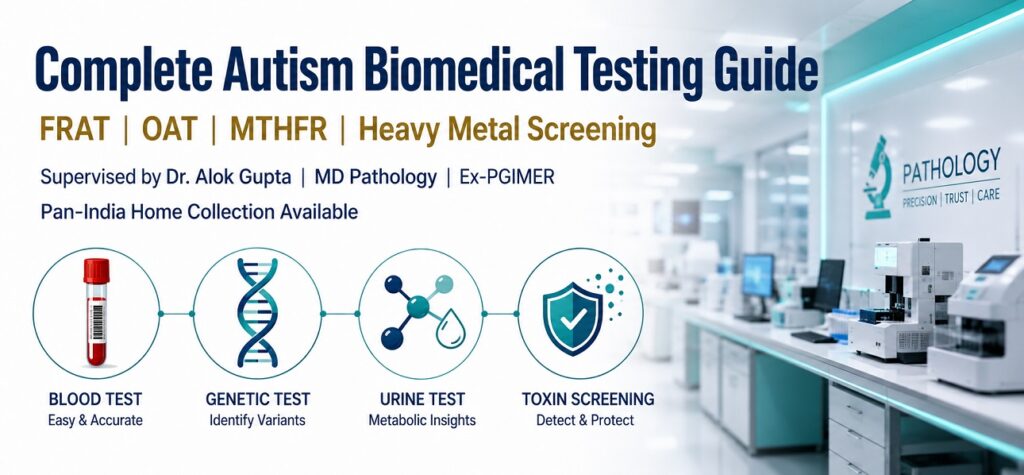
At Altus Lab, four tests form the foundation of a comprehensive biomedical autism workup: the FRAT test, the OAT test, the MTHFR Mutation test, and Heavy Metal Screening. Each test examines a different biological system, and together they provide a far more complete picture than any single test alone. This guide explains what each test does, how they connect to one another, and how to decide which combination is right for your child.
The Four Pillars of Biomedical Autism Testing
Before exploring each test individually, it helps to understand how they fit together. Think of these four tests as four different lenses examining the same child from different angles.
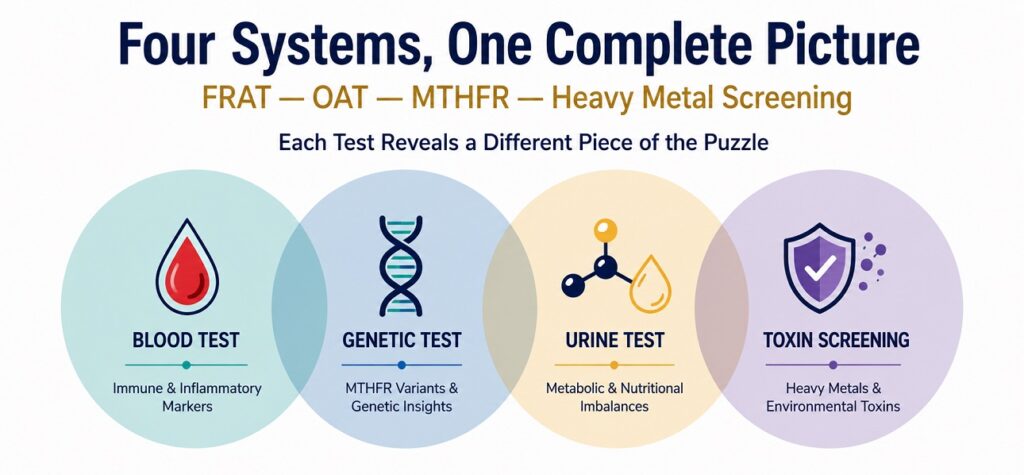
The FRAT test examines whether the immune system is blocking folate from reaching the brain. The OAT test examines how efficiently cells are producing energy and managing gut health. The MTHFR test examines whether a genetic variation is limiting how well the body converts folate into its usable form. Finally, Heavy Metal Screening examines whether toxic metal accumulation is placing additional stress on an already vulnerable nervous system.
Because these four systems interact closely, a child can test positive on one, several, or all four. Understanding each test individually makes it much easier to interpret combined results with your child’s doctor.
FRAT Test — Detecting Folate Receptor Autoantibodies
The FRAT test, short for Folate Receptor Autoantibody Test, detects antibodies that block folate receptor alpha, the protein responsible for transporting folate across the blood-brain barrier. When these antibodies are present, folate cannot reach the brain in adequate amounts, even when blood folate levels appear completely normal.
This condition, known as Cerebral Folate Deficiency, has been linked to autism regression, speech delay, and seizures. Research indicates that up to 75 percent of children with ASD may carry detectable folate receptor autoantibodies, and many FRAT-positive children show meaningful improvement in communication and behaviour after starting leucovorin, or folinic acid, therapy.
At Altus Lab, the FRAT test costs ₹8,500 and is available with pan-India home collection. For a complete breakdown of preparation instructions, procedure, and booking, read our detailed FRAT test guide for India.
OAT Test — Examining Cellular Metabolism and Gut Health
The OAT test, or Organic Acid Test, is a urine-based screening that measures over 70 organic acid markers. Unlike the FRAT test, which focuses specifically on folate transport into the brain, the OAT test looks broadly at how efficiently the body produces energy, whether harmful yeast or bacterial overgrowth is present in the gut, and whether specific vitamin cofactors are being properly utilised.
Many parents are surprised to learn that mitochondrial dysfunction, a frequently missed cause of developmental regression and chronic fatigue, is one of the key findings the OAT test can uncover. Similarly, elevated markers linked to candida overgrowth often explain persistent gut symptoms that standard digestive tests fail to identify.
At Altus Lab, the OAT test is priced at ₹6,500, making it the most affordable specialist option available in India. To understand the full list of markers this test measures and how to prepare for collection, visit our OAT test cost and procedure page.
MTHFR Mutation Test — The Genetic Piece of the Puzzle
While the FRAT test examines an acquired immune response and the OAT test examines cellular metabolism at a point in time, the MTHFR Mutation test looks at something entirely fixed: your child’s genetics.
The MTHFR gene controls how efficiently the body converts folate into its active, usable form. Certain variants, specifically C677T and A1298C, reduce this conversion efficiency, which can lead to elevated homocysteine and impaired methylation throughout the body. Because methylation affects neurotransmitter production and detoxification pathways, an MTHFR mutation is frequently investigated alongside autism and elevated homocysteine findings.
Since this is a one-time genetic test, a child only needs to be tested once in their lifetime. Altus Lab offers this test at ₹6,500 with pan-India home collection. Learn more about the specific variants and what a positive result means on our MTHFR Mutation test page.
Heavy Metal Screening — Ruling Out Toxic Exposure
The fourth pillar of biomedical testing addresses a factor entirely external to genetics and immune function: environmental toxin exposure. Heavy Metal Screening measures levels of lead, mercury, arsenic, and cadmium circulating in the blood.
These metals accumulate silently over months or years, and by the time symptoms like fatigue, poor concentration, or developmental regression appear, meaningful accumulation may have already occurred. Because a standard blood panel does not screen for these toxins at all, a dedicated Heavy Metal Screening test remains the only reliable way to confirm or rule out exposure.
This test is particularly relevant for families living near industrial areas, older buildings, or regions with documented groundwater contamination. Full details on the test, including which specific metals are measured, are available on our Heavy Metal Screening test page.
Which Tests Should Your Child Get First?
Given the cost and emotional weight involved, many parents naturally ask which test to prioritise. While every child’s situation differs, the following approach reflects how most specialists sequence biomedical testing.
Start with the FRAT test, since a positive result opens a well-established treatment pathway through leucovorin therapy, and this test has the strongest body of research linking it directly to autism symptom improvement. Next, consider the MTHFR test, since it is a one-time genetic test that provides lifelong clarity and pairs naturally with FRAT results to give a complete folate metabolism picture.
Following these two, the OAT test provides broader metabolic context, particularly if gut symptoms, fatigue, or unexplained regression are present. Finally, Heavy Metal Screening is especially valuable if your family lives in an area with known environmental risk factors, or if initial results from the other three tests do not fully explain your child’s symptoms.
Many families choose to complete all four tests together as part of a single comprehensive workup, since combined results give your doctor the clearest possible picture in one visit.
Understanding How These Four Results Work Together
Interpreting biomedical test results becomes significantly clearer when you understand how these four systems overlap.
For example, a child with an MTHFR mutation may show elevated homocysteine on the OAT test, since both markers reflect the same underlying methylation pathway. Similarly, a child who tests positive on the FRAT test may also show low functional folate markers on the OAT test, since both point toward folate not reaching where it is needed. Heavy Metal Screening results, meanwhile, provide independent context, since toxic metal exposure can worsen symptoms regardless of a child’s genetic or immune status.
Rather than viewing these four tests as separate, isolated results, your doctor will likely interpret them together as pieces of a single, interconnected biological picture unique to your child.
Cost Summary — All Four Tests at Altus Lab
| Test | What It Detects | Cost |
|---|---|---|
| FRAT Test | Folate receptor autoantibodies blocking brain folate transport | ₹8,500 |
| OAT Test | Cellular energy, gut health, and metabolic markers | ₹6,500 |
| MTHFR Mutation Test | Genetic folate conversion efficiency | ₹6,500 |
| Heavy Metal Screening | Lead, mercury, arsenic, and cadmium toxicity | ₹6,500 |
All four tests are available with free home blood collection across India, with reports supervised by Dr. Alok Gupta, MD Pathology, Ex-PGIMER Chandigarh.
How Booking Works Across India

Booking any combination of these four tests follows the same simple process, regardless of your city. Call or WhatsApp Altus Lab to schedule your preferred tests, and a trained phlebotomist will visit your home to collect the required blood samples in a single visit. Samples are transported to Altus Lab in Chandigarh under proper handling protocols, and your reports are delivered digitally within the standard turnaround window for each test.
Because a phlebotomist visit is required either way, many families choose to combine two or more tests in a single appointment, reducing both cost and inconvenience compared to booking each test separately.
📞 Call: 0172-5017001
💬 WhatsApp: +91-62842-14977
🌐 Pan-India home collection available
Frequently Asked Questions
1. Do I need to do all four tests together?
No. Many families start with the FRAT and MTHFR tests, then add the OAT test or Heavy Metal Screening based on specific symptoms or your doctor’s recommendation.
2. Can these tests be done in a single home visit?
Yes. A single phlebotomist visit can collect blood samples for FRAT, MTHFR, and Heavy Metal Screening together. The OAT test requires a separate urine sample, which can be collected during the same visit.
3. Which test should I prioritise if I can only afford one right now?
The FRAT test is generally recommended first, since a positive result opens a well-established treatment pathway through leucovorin therapy with strong supporting research.
4. Are these tests available outside Chandigarh?
Yes. Altus Lab offers home sample collection across India for all four tests, at the same transparent pricing regardless of city.
5. How do these four tests relate to each other?
Each test examines a different biological system — immune response, cellular metabolism, genetics, and toxin exposure — but they often overlap. For example, an MTHFR mutation and a positive FRAT result can both point toward impaired folate utilisation through different mechanisms.
6. Will my child need to repeat any of these tests?
The MTHFR test is genetic and only needs to be done once. The FRAT, OAT, and Heavy Metal Screening tests may be repeated periodically to monitor treatment response, based on your doctor’s recommendation.
7. Who supervises these tests at Altus Lab?
All four tests are conducted under the direct supervision of Dr. Alok Gupta, MD Pathology, Ex-PGIMER Chandigarh, ensuring clinically reviewed and accurate reporting.
8. Do these tests replace standard autism therapies?
No. Biomedical testing and any resulting treatment, such as leucovorin therapy or dietary changes, are used alongside standard therapies like ABA, speech therapy, and occupational therapy, not as a replacement for them.