

Your Child’s Blood Folate Is Normal, But Something Still Feels Wrong
If your child has been diagnosed with autism spectrum disorder (ASD), or if you have noticed speech delays, unexplained seizures, or regression in development, you have probably run dozens of blood tests already. And most of them came back “normal.”
That is exactly where parents get stuck — and that is exactly the gap the FRAT test fills.
The FRAT test, short for Folate Receptor Autoantibody Test, looks for something that a standard folate test completely misses. It detects whether your child’s immune system is producing antibodies that block folate from entering the brain — even when blood folate levels look perfectly fine.
If you are searching for the FRAT test in India, this guide gives you everything you need: what the test is, why it matters, who should get it, what a positive result means, how the procedure works, and where to book it at the most affordable price anywhere in India.
What Is the FRAT Test? A Clear, Simple Explanation
The FRAT test stands for Folate Receptor Autoantibody Test. It is a specialised blood test that detects autoantibodies — antibodies produced by your own immune system — that attack and block the folate receptor alpha (FRα) protein.
Here is why that matters. Your brain does not absorb folate (Vitamin B9) directly from food the way other organs do. Instead, it depends on a dedicated transport system. Folate receptor alpha proteins line the blood-brain barrier and actively pull folate from your bloodstream into the cerebrospinal fluid (CSF) and then into the brain. When autoantibodies attack these receptors, folate cannot enter the brain in adequate amounts — no matter how many folate-rich foods you eat or how many supplements you take.
This condition is called Cerebral Folate Deficiency (CFD). It was first described by researchers in 2002 and has since been linked to autism spectrum disorder, speech and language delays, infantile-onset seizures, developmental regression, and cognitive impairment.
The critical point is this: a child with cerebral folate deficiency often has completely normal or even high blood folate. A standard serum folate test will miss it entirely. Only the FRAT test can identify the specific antibody-driven mechanism that is blocking folate from reaching the brain.
Why Does the FRAT Test Matter for Autism in India?
FRAT test is not just a diagnostic test. It is a test that can open a treatment pathway. A positive result gives your child’s doctor a clear, evidence-backed option to try leucovorin therapy. Many families across the world have reported meaningful improvements in speech, eye contact, attention, and social behavior after their FRAT-positive children received leucovorin treatment alongside standard therapies.
In India, however, most families do not know this test exists — or they cannot find an affordable, reliable lab to perform it. That is a problem this guide directly addresses.
Signs and Symptoms That Suggest Your Child May Need a FRAT Test
Not every child with autism needs the FRAT test. However, certain signs strongly indicate that cerebral folate deficiency may be playing a role. You should consider booking a FRAT test if your child shows:
Neurological and developmental signs:
- 1. Autism spectrum disorder diagnosis, especially with speech and communication difficulties.
- 2. Significant speech delay or near-absent speech despite therapy
- 3. Developmental regression — skills that appeared and then disappeared
- 4. Infantile-onset seizures or epilepsy that is difficult to control
- 5. Repetitive behaviours, low eye contact, and social withdrawal
- 6. Movement abnormalities, low muscle tone, or coordination difficulties
- 7. Cognitive impairment that is unexplained by other diagnoses
Other clinical indications:
- Diagnosis of schizophrenia or other neuropsychiatric conditions in older patients
- History of neural tube defects in previous pregnancies
- Recurrent pregnancy loss linked to folate metabolism issues
- Unexplained neurological symptoms with normal routine blood work
Furthermore, your doctor may recommend FRAT testing if previous interventions — ABA therapy, speech therapy, folic acid supplements — have produced limited results and your child’s neurological picture remains unclear.

How Does the FRAT Test Work? Step-by-Step Procedure
The FRAT test is a blood test, but it is far more specialised than a routine CBC or serum folate check. Here is what the process looks like:
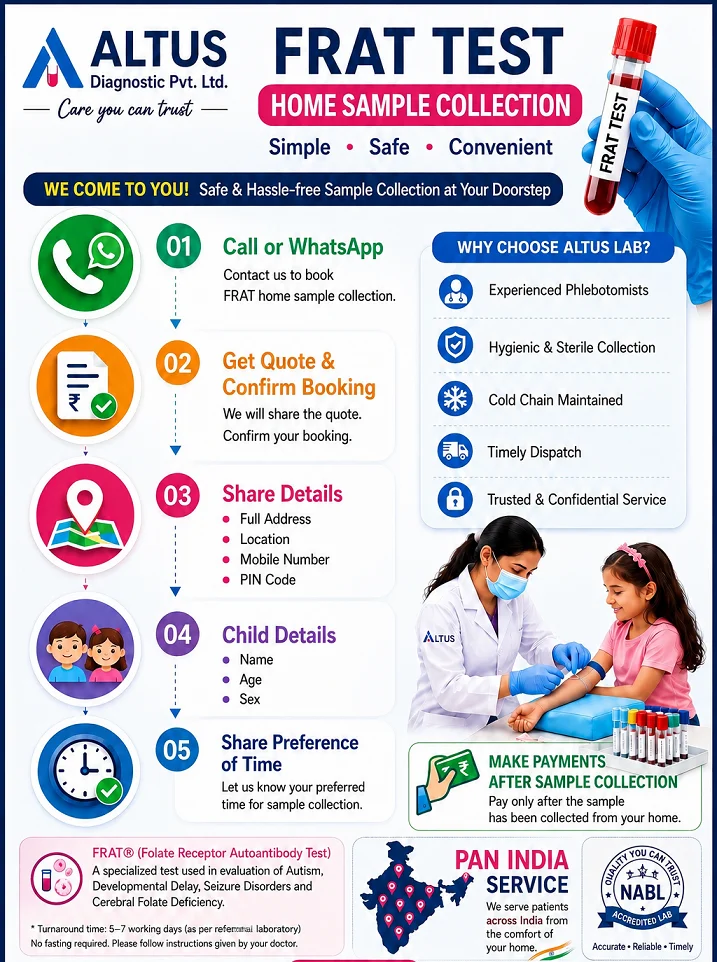
Step 1 — Blood Collection A small blood sample is drawn from a vein, just like any routine blood test. At Altus Lab home blood collection is available across PAN India. For patients across India, a courier-based sample collection service operates pan-India — a trained phlebotomist comes to your doorstep, draws the sample, and ships it to the lab using temperature-controlled logistics.
Step 2 — Laboratory Analysis The blood sample goes through a highly specialized ELISA-based assay to detect and quantify blocking and binding antibodies against the folate receptor alpha protein. This is not a test that every lab can perform. It requires specific technical expertise, validated methodology, and specialist supervision.
Step 3 — Report Delivery At Altus Lab, the typical turnaround time is 7 to 10 working days from the date of sample receipt. For pan-India courier submissions, add 2 to 3 days for transit. Reports are delivered digitally via WhatsApp and email for immediate sharing with your child’s neurologist or specialist.
Step 4 — Interpretation A positive FRAT result means that folate receptor autoantibodies are present and are likely impairing folate transport to the brain. Your child’s doctor then evaluates whether leucovorin (folinic acid) therapy is appropriate. A negative result rules out this specific mechanism, allowing the clinical team to investigate other causes.
FRAT Test Cost in India — Why Altus Lab Offers the Best Price
One of the biggest barriers families face when looking for the FRAT test in India is cost. Several labs charge amounts that are genuinely out of reach for most families:
| Lab / Provider | FRAT Test Price |
| Competitor labs in India | ₹12,500 – ₹20,000 |
| International labs (with consultation) | $595 (approx. ₹50,000+) |
| Altus Lab Chandigarh | ₹8,500 only |
Altus Lab charges just ₹8,500 for the complete FRAT test — performed under direct supervision of a specialist MD Pathologist — while comparable labs in India charge ₹12,500, ₹15,000, and even ₹20,000 for the same test.
Book the FRAT test in India at ₹8,500 — the most affordable specialist price anywhere in India.
🌐 USA-Equivalent Report Standard
Altus Lab’s FRAT test reports meet the same analytical and reporting standards followed by specialist laboratories in the United States, where this test was first developed. Indian families no longer need to send samples abroad or pay international prices — you get USA-equivalent report quality at ₹8,500, right here in India.
Why FRAT Test Prices are Low than Competitors?
The reason Altus Lab can offer this price is straightforward. The lab runs lean, invests in the right equipment, and believes that a critical diagnostic test for children with autism and neurological disorders should not be financially inaccessible. The goal is to help families get answers — not to profit from their desperation.
Additionally, the lower price does not mean lower quality. Altus Lab uses the same validated ELISA-based methodology, maintains strict sample handling protocols, and delivers specialist-supervised reports that neurologists and paediatric specialists across India accept.
Who Performs the FRAT Test at Altus Lab?
The FRAT test at Altus Lab Chandigarh is performed under the direct supervision of Dr. Alok Gupta, MD Pathology, a highly experienced pathologist and the Founder of Altus Lab.
Dr. Alok Gupta trained at PGIMER Chandigarh — the Post Graduate Institute of Medical Education and Research, one of India’s most respected and prestigious medical institutions. His clinical expertise spans over 13 years in specialist diagnostic pathology, and he brings both the scientific rigour and the practical experience that a complex, specialised test like the FRAT demands.
When you book the FRAT test at Altus Lab, your results are not processed by a technician in a bulk-volume commercial chain. They are personally supervised by a qualified MD Pathologist with deep expertise in specialised diagnostic testing. This matters enormously when the result of a test will influence major medical decisions for your child.
FRAT Test for Autism — What Happens After a Positive Result?

A positive FRAT test result is not a reason to panic. Instead, think of it as a reason to act. Here is what typically follows:
1. Discuss results with a paediatric neurologist or metabolic specialist. Your FRAT report from Altus Lab will include quantitative antibody levels. Share this directly with your child’s treating neurologist or developmental paediatrician.
2. Consider leucovorin (folinic acid) therapy. Leucovorin is a prescription medication — a special form of folate that can bypass the blocked folate receptor and still enter the brain. Multiple clinical trials, including studies published in Nature’s Molecular Psychiatry and the Journal of Personalized Medicine, have shown that FRAT-positive children with ASD often respond positively to leucovorin, with improvements in communication, attention, and core ASD symptoms.
3. Adopt a casein-free diet. Dairy proteins (casein) have been shown to stimulate the production of folate receptor autoantibodies. Many specialists recommend a casein-free diet alongside leucovorin therapy to reduce the antibody burden.
4. Follow up with repeat testing. Your doctor may recommend repeating the FRAT test after a period of treatment to monitor antibody levels and assess therapeutic response.
5. Continue all existing therapies. The FRAT test and leucovorin treatment do not replace ABA therapy, speech therapy, or occupational therapy. They address a specific underlying biological mechanism that, when corrected, may enhance the effectiveness of behavioural and developmental interventions.
Is the FRAT Test Available Pan-India? How to Book from Any City
Yes. Altus Lab now offers FRAT test services across all of India through a courier-based sample collection system. Here is how it works if you live outside Chandigarh:
- Call or WhatsApp Altus Lab to confirm your booking and discuss preparation instructions.
- A trained phlebotomist visits your home and collects the blood sample using a sealed, sterile collection kit.
- The sample ships to Altus Lab Chandigarh via temperature-controlled courier logistics.
- The lab processes the sample and delivers your report digitally — via WhatsApp and email — within the agreed turnaround time.
Altus Lab offers pan-India FRAT test services with free home sample collection at your doorstep.
Families from Delhi, Mumbai, Bengaluru, Hyderabad, Pune, Kolkata, Gurugram, Noida, Patna, Jaipur, and hundreds of other cities across India already use this service. Distance is no longer a barrier to accessing this specialised diagnostic test.
If you’re looking for a comprehensive metabolic assessment alongside the FRAT Test, explore our Organic Acid Test (OAT) in India for advanced nutritional and metabolic insights.FRAT Test vs. Standard Folate Test — A Critical Difference Parents Must Understand
Many parents ask: “My child already had a folate blood test and it was normal. Why would the FRAT test show anything different?”
This is one of the most important questions — and the answer could change everything.
A standard serum folate test measures the amount of folate circulating in the blood. It tells you whether your child is folate-deficient in the conventional sense. However, it tells you nothing about whether that folate is successfully reaching the brain.
The FRAT test measures something entirely different. It detects antibodies that are blocking folate receptor alpha — the protein that transports folate from the blood into the brain. A child can have completely normal or even elevated blood folate and still have severe cerebral folate deficiency, because the transport mechanism itself is compromised.
This is why thousands of children with autism have normal routine blood work, yet benefit enormously from the FRAT test and subsequent leucovorin therapy. The standard folate test misses this condition entirely. Only the FRAT test identifies it.
How to Book the FRAT Test at Altus Lab
Booking is simple and straightforward. Contact Altus Lab directly:
📞 Call: 91 62842 14977 💬 WhatsApp: Available for quick booking and queries
🌐 Website: altuslab.in 📍 Lab Address: Altus Lab, Chandigarh (serving all of India pan-India via courier)
When you call, the team at Altus Lab will walk you through preparation instructions, confirm your address for home collection, and provide a precise timeline for report delivery. The FRAT test at Altus Lab costs ₹8,500 — the most affordable specialist pricing anywhere in India.
12 Frequently Asked Questions About the FRAT Test in India
FAQ 1: What is the FRAT test? The FRAT test (Folate Receptor Autoantibody Test) is a specialised blood test that detects autoantibodies blocking the folate receptor alpha protein. When these antibodies are present, folate cannot reach the brain properly, causing a condition called Cerebral Folate Deficiency (CFD). The test helps identify a treatable biological cause underlying autism spectrum disorder, seizures, and other neurodevelopmental conditions.
FAQ 2: What is the FRAT test cost in India? Most labs in India charge between ₹12,500 and ₹20,000 for the FRAT test. Altus Lab Chandigarh offers the FRAT test at just ₹8,500 — the most affordable specialist price in India — supervised by Ex-PGIMER MD Pathologist Dr. Alok Gupta. Pan-India home collection is available with no additional booking fee.
FAQ 3: Who should get the FRAT test done? Children diagnosed with autism spectrum disorder, speech delays, developmental regression, infantile seizures, or cognitive impairment are the primary candidates. Adults with unexplained neurological symptoms, schizophrenia, or a history of neural tube defects in pregnancies may also benefit. If your child’s routine blood work is normal but neurological symptoms persist, the FRAT test is an important next step.
FAQ 4: How is the FRAT test different from a regular folate blood test? A standard folate test measures circulating folate levels in the blood. The FRAT test measures whether antibodies are blocking folate receptor alpha — the protein that transports folate into the brain. A child can have normal blood folate and still have severe cerebral folate deficiency. Only the FRAT test detects this specific condition.
FAQ 5: Is any preparation required before the FRAT test? Yes. Your child should fast for at least 4 to 6 hours before the blood draw. More importantly, follow a casein-free diet — avoid all dairy products including milk, cheese, and yogurt — for 3 to 4 days before the test. Casein proteins can temporarily elevate folate receptor antibody levels and affect accuracy.
FAQ 6: What does a positive FRAT test result mean? A positive result means that folate receptor autoantibodies are present and are likely blocking folate from entering your child’s brain. This is not a final diagnosis, but it is a critical finding. Your child’s neurologist will typically evaluate leucovorin (folinic acid) therapy, a prescription form of folate that can bypass the blocked receptors and reach the brain through an alternative pathway.
FAQ 7: What does a negative FRAT test result mean? A negative result means that folate receptor autoantibodies are not detected at significant levels. Cerebral folate deficiency caused by this specific antibody mechanism is unlikely. However, other causes of brain folate insufficiency — such as genetic mutations in the FOLR1 gene — may still be investigated based on your child’s clinical picture.
FAQ 8: How long does it take to get FRAT test results in India? At Altus Lab, the typical turnaround time is 7 to 10 working days from the date of sample receipt at the lab. For pan-India courier submissions, please add 2 to 3 days for transit. Reports are delivered digitally via WhatsApp and email.
FAQ 9: Is the FRAT test available outside Chandigarh? Yes. Altus Lab offers pan-India FRAT test services through courier-based home sample collection. A trained phlebotomist collects the blood sample at your home anywhere in India, and the sample is shipped to Chandigarh via temperature-controlled courier. Families from Delhi, Mumbai, Bengaluru, Hyderabad, Chennai, Pune, Kolkata, Ahmedabad, Jaipur, Lucknow, and all other Indian cities can access this service.
FAQ 10: Who performs and supervises the FRAT test at Altus Lab? The FRAT test at Altus Lab is supervised by Dr. Alok Gupta, MD Pathology, Ex-PGIMER Chandigarh. Dr. Gupta has over 13 years of specialist diagnostic experience and founded Altus Lab to bring high-quality, affordable specialised diagnostic testing to patients across India. Your reports carry the authority of a specialist pathologist — not a bulk-processing commercial chain.
FAQ 11: Can the FRAT test cure autism? No. The FRAT test is a diagnostic test, not a treatment. It identifies whether folate receptor autoantibodies are blocking brain folate transport. If the result is positive, your child’s doctor may prescribe leucovorin (folinic acid) therapy. Leucovorin treats cerebral folate deficiency — a specific biological condition that may be contributing to your child’s symptoms. Many families report meaningful improvements in communication and behaviour with leucovorin therapy in FRAT-positive children, but results vary and leucovorin is used alongside, not instead of, established therapies like ABA and speech therapy.
FAQ 12: Why is the FRAT test at Altus Lab cheaper than other labs? Altus Lab charges ₹8,500 because the goal is to make this critical diagnostic test accessible to every family in India who needs it. Competitor labs charge ₹12,500 to ₹20,000 for the same test. Altus Lab invests in validated methodology, specialist-supervised reporting, and efficient lab operations — and passes the savings directly to families. A lower price reflects commitment, not compromise in quality.