
Many parents of children with autism become familiar with behavioural therapies, speech interventions, and structured routines designed to support development.
However, fewer families realise that some children with autism may also have an underlying metabolic condition affecting brain function. Identifying these biological factors can sometimes help doctors better understand the child’s symptoms.
One condition that has received growing scientific attention is Cerebral Folate Deficiency (CFD).
Research suggests that cerebral folate deficiency symptoms in autism may appear in a subset of children with autism spectrum disorder. Doctors can investigate this possibility through a specialised blood test called the Folate Receptor Antibody Test (FRAT).
When detected early, this condition may respond to targeted treatment that supports neurological development.
Understanding the symptoms, testing process, and treatment options can help parents and clinicians explore potential biological contributors to autism symptoms.
What Is Cerebral Folate Deficiency?
Folate, also known as vitamin B9, plays a critical role in brain development and neurological health.
The brain depends on folate for several essential biological processes, including:
- DNA synthesis
- Repair of damaged cells
- Production of neurotransmitters
- Formation of myelin around nerve cells
Because the brain cannot produce folate on its own, it must receive it from the bloodstream.
This transport occurs through a specialised receptor called folate receptor alpha (FRα) located at the blood–brain barrier.
In Cerebral Folate Deficiency, the brain does not receive enough folate even when blood folate levels appear normal.
The most common reason for this disruption is the presence of Folate Receptor Blocking Antibodies (FRBAs).
These antibodies bind to the folate receptor and prevent folate from entering the brain.
As a result, the brain becomes chronically under-supplied with a nutrient that is essential for neurological development, cell repair, and healthy brain signalling.
Why Researchers Study Cerebral Folate Deficiency in Autism
Over the past decade, researchers have increasingly examined the connection between cerebral folate deficiency and autism spectrum disorder (ASD).
Several studies have reported that folate receptor antibodies appear far more frequently in children with autism than in neurotypical children.
Research led by Dr. Richard Frye and colleagues found that up to 75% of children with autism tested positive for these antibodies in certain study populations.
This finding has encouraged clinicians to explore metabolic factors more carefully when evaluating developmental conditions.
It is important to understand that Cerebral Folate Deficiency does not cause autism.
Instead, it appears to be a co-occurring biological condition that may worsen neurological symptoms.
Recognising cerebral folate deficiency symptoms in autism may help doctors investigate metabolic causes that could influence a child’s development.
Cerebral Folate Deficiency Symptoms in Autism
Cerebral Folate Deficiency does not always produce symptoms that are clearly different from autism itself.
Because of this overlap, the condition can remain undiagnosed without specialised testing.
However, some clinical patterns may prompt doctors to investigate further.
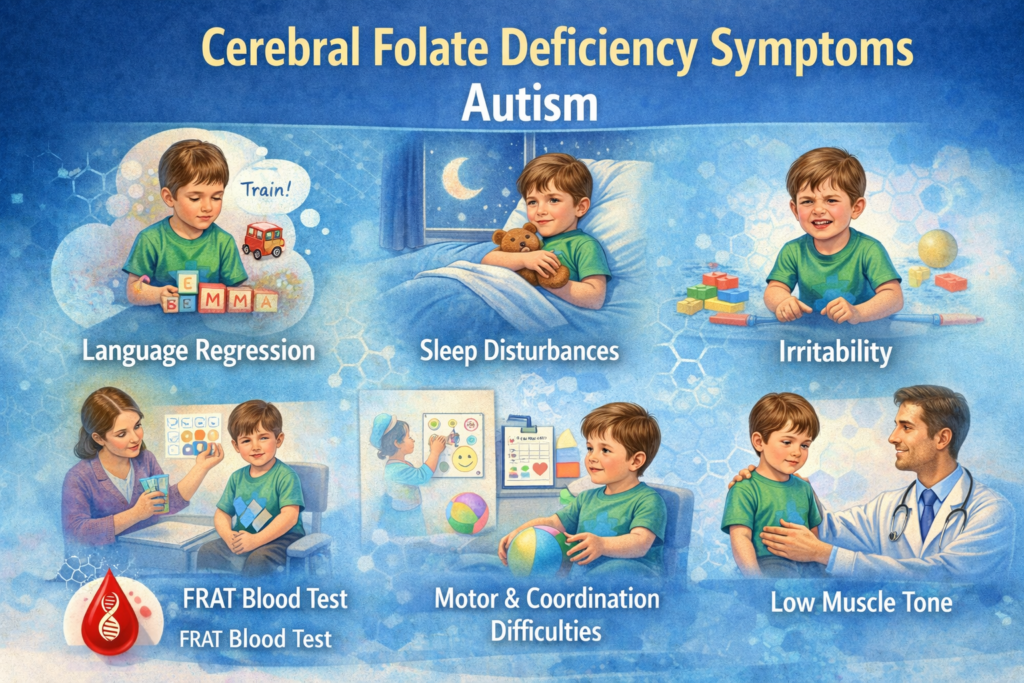
Possible cerebral folate deficiency symptoms in autism include:
- Language regression or delayed speech development
- Limited improvement despite consistent behavioural therapy
- Persistent sleep disturbances
- Increased irritability or emotional dysregulation
- Motor coordination difficulties
- Low muscle tone (hypotonia) in younger children
These symptoms alone cannot confirm Cerebral Folate Deficiency.
However, they may lead clinicians to investigate whether folate receptor antibodies are present.
How the FRAT Test Diagnoses Cerebral Folate Deficiency
The Folate Receptor Antibody Test (FRAT) is designed to detect antibodies that block folate transport into the brain.
This test differs from standard folate testing.
A child may show normal folate levels in routine blood tests while still experiencing impaired folate transport to the brain.
The FRAT test specifically measures antibodies that interfere with the folate receptor.
The testing process is straightforward for the child.
It usually involves the following steps:
- A small blood sample is collected
- No fasting is required
- The sample is stored under refrigerated conditions
- The sample is transported to a specialised reference laboratory
- Laboratory analysis measures antibody levels
Results are usually available within 7 to 10 working days.
If the test detects folate receptor blocking antibodies, doctors gain valuable information that can help guide treatment decisions.
Treatment for Cerebral Folate Deficiency
If the FRAT test confirms the presence of blocking antibodies, doctors may recommend folinic acid therapy.
Folinic acid differs from standard folic acid in an important way.
Regular folic acid depends on the folate receptor pathway to enter the brain. When antibodies block this receptor, folic acid cannot reach brain tissue effectively.
Folinic acid, however, can enter the brain through alternative transport pathways.
This allows the brain to receive the folate required for healthy neurological development.
Treatment is typically managed by a paediatric neurologist or developmental specialist.
Doctors monitor the child’s progress through clinical observations and follow-up testing.
Clinical studies have reported improvements in several areas, including:
- Verbal communication
- Social interaction
- Attention and focus
- Sleep quality
- Behavioural regulation
Every child responds differently.
Some families notice changes within weeks, while others observe gradual improvements over several months.
Why the FRAT Test Requires Specialised Laboratory Handling
The FRAT test for cerebral folate deficiency requires careful laboratory handling.
Blood samples must remain refrigerated during transport and must reach a certified reference laboratory within a specific timeframe.
Because of these strict handling requirements, not every diagnostic laboratory offers this test.
Proper sample collection, storage, and transport are essential to ensure accurate results.
FRAT Testing at Altus Medical Laboratory Chandigarh
At Altus Medical Laboratory in Chandigarh, specialised protocols ensure that samples for the FRAT test are handled correctly.
Our laboratory team manages the complete process, including sample collection and cold-chain transport to the reference laboratory.
We also offer home blood collection services, which can be especially helpful for children with autism who may find clinic visits stressful.
Our trained phlebotomists work patiently with children and families to ensure a calm and comfortable experience.
Accurate testing allows doctors to investigate possible metabolic factors contributing to autism symptoms.
Why Early Testing Matters
Understanding the biological factors influencing neurological development can help doctors design more targeted treatment strategies.
Testing does not replace behavioural therapies or developmental support.
Instead, it provides additional information that may guide treatment decisions.
For families navigating autism diagnosis and care, identifying conditions such as Cerebral Folate Deficiency may open new possibilities for medical support.
Recognising cerebral folate deficiency symptoms in autism and confirming the diagnosis through the FRAT blood test can help clinicians explore treatment approaches that support a child’s neurological development.