
Folinic Acid vs Folic Acid Autism: Why the Difference Matters
If your child has been diagnosed with autism, or if you have been researching the role of nutrition and metabolic health in ASD, you may have come across discussions about folinic acid vs folic acid autism treatment. Many parents naturally wonder whether these two nutrients are the same and whether a standard vitamin B supplement might help.
The short answer is no — and the distinction is biologically important. This article explains the difference between folinic acid and folic acid, why that difference matters for children with autism-related Cerebral Folate Deficiency (CFD), and why testing should come before any supplementation.
Folic Acid and Folinic Acid: Are They Not the Same Thing?
Both folic acid and folinic acid are forms of folate — vitamin B9. Folate is a broad term for a family of related compounds that the body needs for cell division, DNA synthesis, and the production of neurotransmitters.
However, when discussing folinic acid vs folic acid autism treatment, the differences in how the body processes these compounds become very important.
Folic Acid (Pteroylmonoglutamic Acid)
Folic acid is the synthetic form of folate most commonly found in supplements, fortified foods, and prenatal vitamins. After ingestion, it must be converted by the body into active forms of folate before it can be used. This conversion depends on certain enzymes (including DHFR and MTHFR), and some individuals have genetic variants that make this conversion less efficient.
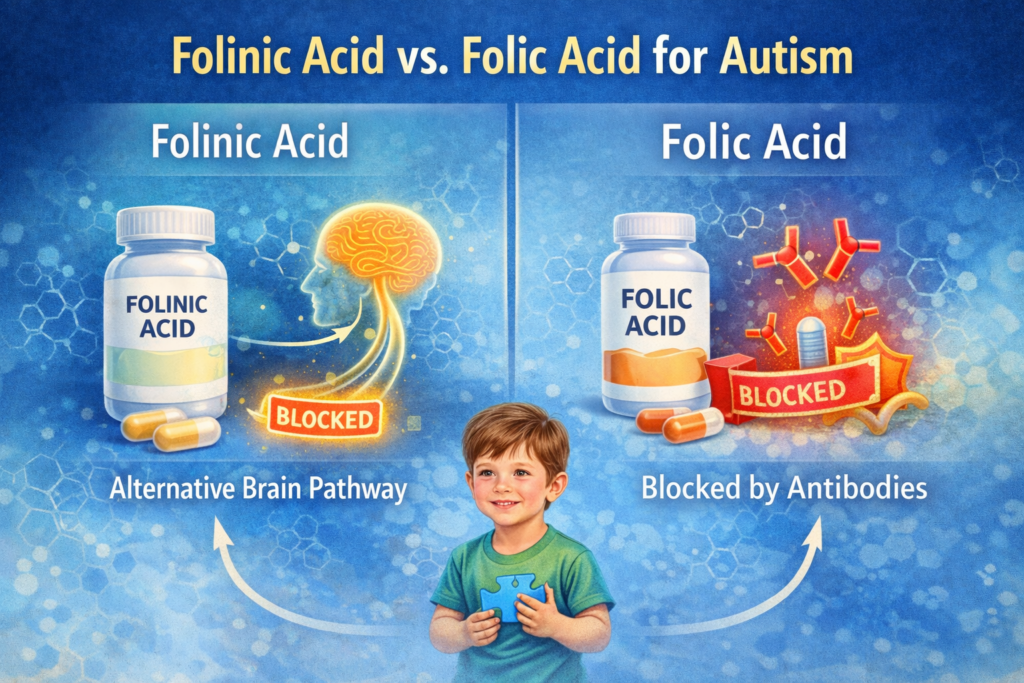
For folate to reach the brain, it must be transported across the blood-brain barrier via the Folate Receptor Alpha (FRα) protein. If a child has Folate Receptor Blocking Antibodies — as many children with autism do — folic acid cannot be transported efficiently into the brain regardless of how much is consumed.
This limitation is one of the key reasons why the discussion of folinic acid vs folic acid autism therapy matters clinically.
Folinic Acid (5-Formyltetrahydrofolate)
Folinic acid is a naturally occurring, reduced form of folate that is already in an active state. Unlike folic acid, folinic acid does not require the same enzymatic conversion steps before the body can use it.
More importantly for children with Cerebral Folate Deficiency, folinic acid can enter the brain through alternative transport pathways that are not blocked by the same antibodies that impair the FRα receptor.
This is why paediatric neurologists treating CFD in children with autism specifically prescribe folinic acid rather than standard folic acid. Giving folic acid when the receptor pathway is blocked is like trying to use a key that no longer fits the lock. Folinic acid finds a different door.
Why Folinic Acid vs Folic Acid Matters in Autism
The distinction between folinic acid vs folic acid autism treatment is not merely academic. Parents who have heard about folate and autism sometimes begin supplementing their child with high-dose folic acid — the form available over the counter.
If the child has CFD driven by Folate Receptor Blocking Antibodies, this supplementation is unlikely to reach the brain in meaningful quantities. Some research also suggests that excess unmetabolised folic acid in the bloodstream may compete with active folate forms for available transport pathways.
The clinical protocol for CFD-associated autism is clear:
- Test first — confirm the presence of Folate Receptor Blocking Antibodies via the FRAT blood test
- If positive, a neurologist prescribes folinic acid at a therapeutic dose
- Monitor — repeat FRAT testing and clinical review after several months
- Do not substitute standard folic acid for folinic acid in this context
What About MTHFR Variants and Methylfolate?
Some parents researching autism and genetics encounter another form of folate called methylfolate (5-MTHF), particularly in relation to MTHFR gene variants.
Methylfolate is an active form of folate and can be useful for individuals who have difficulty converting folic acid. However, methylfolate is not the same as folinic acid.
When discussing folinic acid vs folic acid autism therapy, it is important to understand that methylfolate still relies primarily on the FRα receptor for transport into the brain. If that receptor is blocked by antibodies, methylfolate may face the same limitations as folic acid.
This is precisely why the FRAT test result matters — it provides the clinical basis for choosing the right form of folate intervention.
Is Folinic Acid Safe for Children?
Folinic acid has a well-established safety profile and has been widely studied in clinical medicine. and has been used in clinical practice for decades, including in oncology patients receiving methotrexate treatment.
In the context of autism and CFD, it may be used at therapeutic doses under medical supervision. Side effects at appropriate doses are uncommon.
The most important point is that folinic acid treatment for CFD should always be initiated and monitored by a qualified paediatric neurologist.
The Testing Step You Should Not Skip
Parents sometimes ask whether they can simply try folinic acid supplementation without performing the FRAT test first. Clinically, this approach is not recommended.
- Without testing, it is impossible to confirm whether CFD is contributing to the child’s symptoms
- The FRAT test establishes a baseline antibody titre
- Treatment decisions should involve a neurologist reviewing laboratory results
- Other neurological conditions can mimic some features of CFD
The FRAT test is a straightforward blood draw that provides objective clinical data for your child’s medical team.
Arrange the FRAT Test at Altus Lab, Chandigarh
Altus Medical Laboratory offers FRAT testing in Chandigarh with home blood collection available. We ensure cold-chain compliance from collection to dispatch so the integrity of your child’s sample is protected.
If your child’s neurologist has recommended FRAT testing, or if you would like to understand the process before speaking with your doctor, contact us on 0172-5017001 or +91 628 421 4977.
Visit our FRAT Test page for full details on how to book the test, what it involves, and how results are reported.