
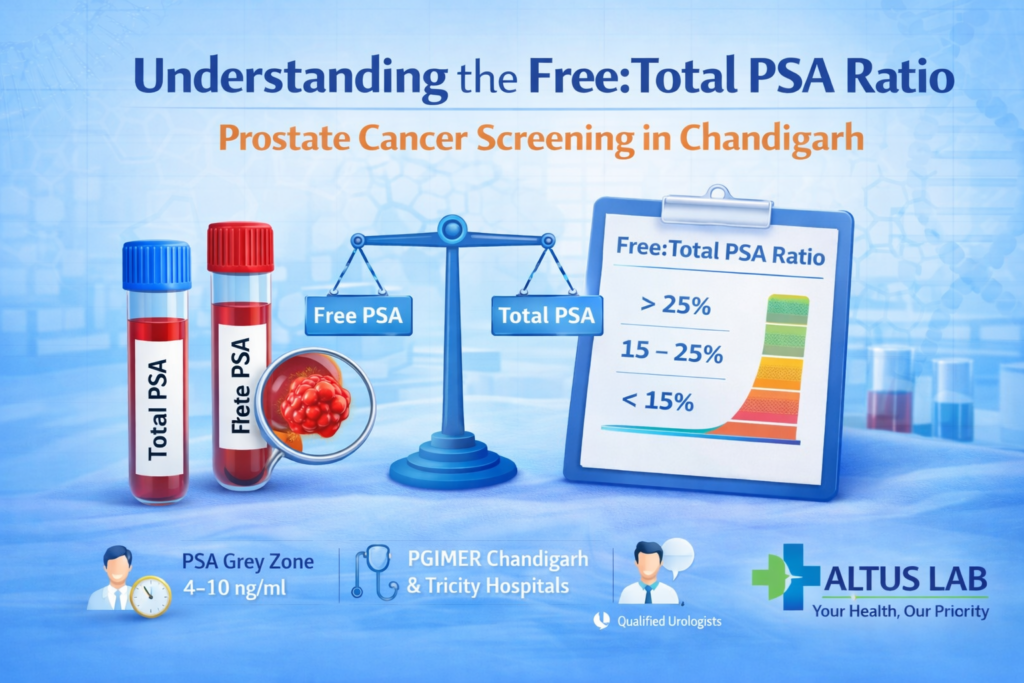
The Free Total PSA Ratio is an important parameter used by doctors to better understand PSA blood test results and evaluate the risk of prostate cancer. Prostate cancer is one of the most common cancers affecting men over the age of 50 worldwide, and its incidence in India has been steadily increasing in recent years. In cities like Chandigarh, Mohali, and Panchkula, urologists frequently recommend PSA blood testing as part of routine prostate health screening.
However, many patients become confused when they see multiple values reported in their PSA test results, including:
- Total PSA
- Free PSA
- Free Total PSA Ratio
Understanding this ratio is important because it helps doctors determine whether an elevated PSA level is more likely caused by prostate cancer or by a benign condition such as prostate enlargement.
This guide explains what the Free:Total PSA ratio means, why doctors use it, and how it helps patients in Chandigarh make better decisions about prostate cancer screening.
What Is PSA?
PSA (Prostate Specific Antigen) is a protein produced by cells of the prostate gland. A small amount of PSA normally circulates in the bloodstream of all men.
Doctors measure PSA levels through a simple blood test, and higher levels may indicate:
- Prostate cancer
- Benign Prostatic Hyperplasia (BPH)
- Prostate infection (prostatitis)
- Urinary tract infection
- Recent ejaculation or prostate manipulation
Because PSA can increase for many non-cancerous reasons, doctors often need additional information to interpret PSA levels accurately.
This is where the Free:Total PSA ratio becomes extremely useful.
Total PSA vs Free PSA – What Is the Difference?
When PSA circulates in the bloodstream, it exists in two forms:
1. Bound PSA
Most PSA in the blood is attached to proteins.
2. Free PSA
A smaller portion circulates freely in the blood without binding to proteins.
A Total PSA test measures both forms combined, while a Free PSA test measures only the unbound portion.
The Free:Total PSA ratio compares the amount of free PSA to total PSA.
Doctors use this ratio to determine the likelihood that elevated PSA levels are caused by prostate cancer rather than benign prostate enlargement.
Why the Free Total PSA Ratio Matters?
The Free:Total PSA ratio becomes especially important when Total PSA falls in the borderline range of 4–10 ng/mL.
Doctors often refer to this range as the “PSA grey zone.”
In this range:
- Many men do not have cancer
- But some do have early prostate cancer
The Free PSA ratio helps doctors estimate risk more accurately.
General Interpretation
| Free:Total PSA Ratio | Cancer Risk Interpretation |
|---|---|
| Above 25% | Lower likelihood of prostate cancer |
| 15–25% | Intermediate risk |
| Below 15% | Higher suspicion of prostate cancer |
When the ratio is low, doctors may recommend further testing such as prostate MRI or biopsy.
Example: How Doctors Use the Ratio
Consider two patients with the same PSA level:
Patient A
Total PSA: 6.2 ng/mL
Free PSA Ratio: 30%
Interpretation:
More likely benign prostate enlargement (BPH).
Patient B
Total PSA: 6.2 ng/mL
Free PSA Ratio: 10%
Interpretation:
Higher suspicion of prostate cancer, and further evaluation may be recommended.
This is why most urologists in Chandigarh hospitals prefer ordering both Total PSA and Free PSA together.
PSA Testing in Chandigarh – How Doctors Use Free Total PSA Ratio?
In the Tricity region, PSA testing is commonly recommended by urologists at hospitals such as:
- PGIMER Chandigarh
- GMCH-32 Chandigarh
- GMCH-16 Chandigarh
- Fortis Hospital Mohali
- Max Super Speciality Hospital Mohali
Doctors use PSA and Free PSA testing in several situations:
Prostate Cancer Screening
Men above 50 years of age are typically advised to undergo PSA screening.
Early Screening for High-Risk Patients
Men above 40 years with a family history of prostate cancer may need earlier screening.
Monitoring Elevated PSA
If PSA is slightly elevated, doctors may monitor changes over time.
Post-Treatment Monitoring
After prostate cancer surgery or radiation therapy, PSA testing helps detect recurrence early.
What Can Cause PSA Levels to Rise Besides Cancer?
Many patients panic when they see an elevated PSA level, but it is important to understand that most PSA elevations are not caused by cancer.
Common causes include:
- Benign Prostatic Hyperplasia (BPH)
- Prostate inflammation (prostatitis)
- Urinary infections
- Recent ejaculation
- Prostate biopsy or catheterization
- Cycling or prolonged pressure on the prostate
Because of these possibilities, doctors often repeat PSA testing before recommending invasive procedures.
PSA Velocity – Another Important Factor
Doctors do not rely only on a single PSA result.
They also evaluate PSA velocity, which measures how quickly PSA levels rise over time.
A commonly used clinical rule is:
An increase greater than 0.75 ng/mL per year may raise suspicion of prostate cancer.
For this reason, doctors often recommend annual PSA testing for men over 50.
Who Should Consider PSA Testing in Chandigarh?
Men in the following groups should consider prostate screening:
- Men over 50 years old
- Men over 40 with a family history of prostate cancer
- Men experiencing difficulty urinating
- Men with frequent night urination
- Men with blood in urine
- Patients undergoing prostate treatment follow-up
Early prostate cancer often produces no symptoms, which is why screening becomes important with increasing age.
Normal PSA Levels by Age
Doctors often interpret PSA levels differently based on age.
| Age Group | Typical PSA Range |
|---|---|
| 40–49 years | 0–2.5 ng/mL |
| 50–59 years | 0–3.5 ng/mL |
| 60–69 years | 0–4.5 ng/mL |
| 70+ years | 0–6.5 ng/mL |
However, PSA results should always be interpreted by a qualified urologist, considering symptoms and clinical history.
Why Understanding PSA Results Is Important
Misinterpreting PSA results can lead to unnecessary anxiety or unnecessary testing.
Understanding the Free:Total PSA ratio helps patients:
- Better understand their test reports
- Discuss results with their doctor more confidently
- Avoid unnecessary biopsies when risk is low
- Detect prostate cancer earlier when risk is higher
For patients in Chandigarh, Mohali, and Panchkula, discussing PSA results with a qualified urologist remains the most reliable approach.
Final Thoughts
The Free:Total PSA ratio is one of the most valuable tools doctors use to interpret borderline PSA results. Instead of relying on a single PSA number, the ratio provides additional context that helps differentiate between benign prostate enlargement and possible prostate cancer.
With prostate cancer becoming more common in India, particularly among men over 50, regular PSA screening and informed interpretation of results are essential for early detection and better outcomes.
Men living in Chandigarh, Mohali, Panchkula, Zirakpur, and surrounding areas should consider discussing prostate screening with their doctor as part of routine health care.